
| Mean (95% CI) | Std. Error Mean | Median | SD | Range | |
|---|---|---|---|---|---|
| Men | Men | Men | Men | Men | Men |
| Age | 68.9 (68.04–69.82) | 0.5 | 67 | 10.2 | 51–95 |
| Procrastination | 27.8 (26.78–28.74) | 0.5 | 27 | 11.1 | 4–60 |
| Depressive Symptomatology | 1.3 (1.10–1.42) | 0.1 | 1 | 1.8 | 0–8 |
| Women | Women | Women | Women | Women | Women |
| Age | 67.8 (67.15–68.50) | 0.3 | 66 | 9.9 | 50–95 |
| Procrastination | 28.7 (27.85–29.48) | 0.4 | 27 | 12.0 | 1–60 |
| Depressive Symptomatology | 1.8 (1.62–1.92) | 0.1 | 1 | 2.2 | 0–8 |
Procrastination and preventive health-care in the older U.S. population
Abstract
Maintaining health preventive behaviors throughout life reduces the risk of non-communicable diseases. However, these behaviours often require effort and discipline to adopt, and may be prone to procrastination. This study examined whether procrastination affected engagement in health preventive behaviors among older adults. We applied generalised additive models to data from the 2020 wave of the United States Health and Retirement Study. Our analytic sample consisted of adults aged \(50+ (n = 1338; \, \text{mean} = 68.24; \, \text{range} = 50-95)\). We focused on six health preventive behaviors: prostate exams, mammograms, cholesterol screenings, pap smears, flu shots, and dental visits. We evaluated depressive symptomatology and procrastination as predictors of these six behaviours. Procrastination was associated with less frequent engagement in mammograms and cholesterol screenings among women, though it had no significant association with pap smears or flu shots. Additionally, procrastination interacted with depression reducing the likelihood of prostate exams in men and dental visits in both men and women, such that individuals with high procrastination and low depression were associated with less frequent engagement in both preventive health behaviours. Procrastination may be a behavioral risk factor for maintaining optimal health in older adults. Given that procrastination is a potentially modifiable behaviour, interventions aimed at reducing procrastination, such as simplifying tasks or providing default appointment, could improve engagement in critical health preventive behaviors.
TipThis chapter of my thesis is published in Preventive Medicine
Monaghan, C., de Andrade Moral, R, & McHugh Power, J. (2025). Procrastination and preventive health-care in the older U.S. population. Preventive Medicine, 190, 108185. 10.1016/j.ypmed.2024.108185
Introduction
Procrastination, defined as the deliberate delay of an intended course of action despite expecting negative consequences (Steel, 2007) has been the subject of extensive study over the last two decades. Procrastination can be conceptualized as both a characteristic trait and a coping strategy for dealing with the unpleasant emotions often associated with challenging tasks (Sirois & Pychyl, 2016a). While studies have demonstrated its deleterious impact on productivity (Asio, 2021; Kim & Seo, 2015), the consequences of procrastination likely extend beyond productivity and into health and well-being (Sirois et al., 2023). Notably, chronic procrastination is associated with heightened stress (Flett et al., 2012; Johansson et al., 2023; Sirois et al., 2003; Sirois, 2007; Stead et al., 2010; Tice & Baumeister, 1997), increased depression (Johansson et al., 2023; Shi et al., 2019; Stead et al., 2010), unhealthy lifestyle behaviours (Johansson et al., 2023; S. M. Kelly & Walton, 2021; Sirois, 2007) and a greater incidence of physical illnesses and symptoms (Johansson et al., 2023; Sirois et al., 2003; Sirois, 2007, 2015).
Procrastination may affect health through both direct and indirect pathways. The procrastination health model (Sirois et al., 2003; Sirois, 2007) proposes that procrastination may negatively impact health via the generation of stress, which could cause hypothalamic-pituitary-adrenal (HPA) axis activation, and sympathetic activation (Bengel & Schwaiger, 2004; Jedema & Grace, 2004; Sirois & Pychyl, 2016b; Stephens & Wand, 2012), leading to health decline (Sirois et al., 2023). Moreover, procrastination can impact mental health, by leading to self-blame, criticism, and depression (Flett et al., 2012; McCown et al., 2012; Monaghan et al., 2024; Sirois, 2014).
Another pathway through which procrastination might influence health is via its putative impact on engagement in preventive health behaviours - routine health check-ups and screenings, which are essential for the early detection and treatment of potential health issues. Previous research exploring predictors of preventive health behaviours has highlighted the critical role of psychosocial factors, among which procrastination may fall (Andersen, 2008; Andersen & Newman, 1973; Veazie & Denham, 2021).
It is critical to explore psychosocial predictors of preventive health behaviours, because while such behaviours are critical for maintaining health, they often require effort and discipline to adopt (S. Kelly et al., 2016; Turk & Meichenbaum, 1991), and can stimulate negative emotions. Additionally, public health messages that aim to encourage preventive health behaviors may trigger negative emotions in some people, which can lead them to procrastinate instead of acting (Sirois, 2017). Understanding such psychosocial predictors of preventive health behaviours, including procrastination, may allow us to better determine the likelihood of their uptake.
Research has to date predominantly focused on student and younger adult populations, often overlooking older adults. This is of concern as the health consequences of procrastination may become even more profound with increasing age. Ageing is a complex biological process that can weaken the body’s defenses against various health problems and diseases (Bandaranayake & Shaw, 2016; Ferrucci et al., 2008; Kulminski et al., 2007) making health management increasingly important as one ages. Older adults can face critical health-related decisions, such as selecting treatment options, adhering to medication regimens, or changing lifestyle habits, which may cause task overload. Procrastination may exacerbate this overload, as the effort required to manage multiple health tasks could become overwhelming.
Preventive health behaviours among older adults are further complicated by the presence of national policy recommendations (US Preventive Services Task Force, 2018b, 2018a, 2024). In the United States (U.S.), policy recommendations suggest that adults are screened for early detection of diseases like cancer, which becomes more likely with age (Rawla, 2019; Sun et al., 2017). In 2022, prostate and breast cancer caused over \(38{,}165\) and \(37{,}841\) deaths respectively among U.S. adults aged 60+ (The International Agency for Research on Cancer, 2024). However, in both the US and United Kingdom, such screening is not recommended beyond a certain age, since their benefits may not outweigh associated risks or costs (Grad et al., 2019; Hugosson, 2018). As such, any exploration of preventive health behaviours in older adults must take into account the prevailing policy recommendations.
Within age ranges where screening behaviors are recommended, procrastination may interfere (Johansson et al., 2023; Sirois et al., 2003; Sirois, 2015). For older adults, procrastinating preventive healthcare, particularly those that are infrequent, such as screenings and checkups, can have significant consequences; a delayed screening leading to an undetected disease can result in more severe deterioration with age (Diehr et al., 2013). Numerous studies have utilised and extended the procrastination health model to establish links between procrastination and health (Johansson et al., 2023; Rapoport et al., 2024; Sirois et al., 2003; Sirois, 2007, 2017; Stead et al., 2010). Within these studies, only two have a focus on older adult procrastination, but both examine specific health outcomes, namely sleep quality (Firdaus et al., 2020) and tooth loss (Shimamura et al., 2022), respectively. Notably, Rapoport et al. (2024) found that procrastination had a negative impact on dental attendance. Beyond this, we could not find evidence of prior research into general preventive health behaviours as a consequence of procrastination in later life, a gap further acknowledged by Rapoport et al. (2024).
As such, this study aimed to explore the associations between procrastination and a range of preventive health behaviors, including prostate exams, mammograms, pap smears, cholesterol screenings, flu shots, and dental visits, in older US adults. Given that these behaviors typically require infrequent action, and prior research (while limited) has shown that procrastination can impact them (Rapoport et al., 2024), it was expected that high scores on measures of procrastination would be associated with lower engagement in these behaviors. Additionally, considering the multifaceted nature of proactive health management, we expected interactions between procrastination, depression, and age for certain preventive health behaviors.
Methods
Design and Participants
This study used data from the United States Health and Retirement Study (HRS; Juster & Suzman (1995)). The HRS is a longitudinal dataset managed by the Institute for Social Research at the University of Michigan and tracks the health, economic, and social well-being of American adults primarily aged 50 and older. Our analyses focused on data from the 2020 wave of the HRS, specifically targeting respondents who completed a “long-term care insurance procrastination” module during that period. This module comprised two parts, with the second segment incorporating a procrastination measure designed to investigate its impact on decision-making in later life.
Measures
Predictor: Procrastination
General procrastination tendencies were measured using the Pure Procrastination Scale (Steel, 2010). This scale consists of 12 items that were measured on a Likert scale ranging from 1 (strongly disagree) to 5 (strongly agree). When combined, these item scores give rise to a total procrastination score ranging from 12 to 60, with higher scores indicating higher levels of procrastination. The scale had a Cronbach’s \(\alpha\) score of 0.91 in this sample, indicating high internal consistency. An example of a question from the scale includes “I delay making decisions until it’s too late”.
Covariate: Depressive Symptomatology
Depressive symptoms were included in our model based on a priori knowledge of their associations with procrastination (Monaghan et al., 2024) and health protection (Clayborne & Colman, 2019). Depressive symptoms were measured using the CESD-8, a shortened eight item version of the Centre for Epidemiological Studies – Depression scale. This scale has been shown to be a valid and reliable measure of depressive symptoms in older adults (Briggs et al., 2018). The scale consists of 8 items that are scored as either 0 (no) or 1 (yes), with items 4 and 6 being reversed scored. The total depression score ranged from 0 to 8, with higher scores indicating higher levels of depressive symptoms. The scale had a Cronbach’s \(\alpha\) score of 0.82 in this sample, indicating high internal consistency. An example of a question from the scale includes “how much of the time during the past week did you feel everything you did was an effort”.
Outcomes: Health Preventive Behaviours
The HRS systematically evaluates and gathers data on a variety of health preventive screenings and behaviours during each wave. The protective measures encompass a comprehensive range of behaviours, such as prostate exams, mammograms, cholesterol screenings, pap smears, flu shots, and visiting the dentist. For each screening, participants self-report whether they have undergone the procedure within the past two years, which is then recorded as a binary score: 0 (no) or 1 (yes). An example of one of these questions includes: “In the last two years, have you had a mammogram or x-ray of the breast, to search for cancer”.
Covariates
Several covariates, chronic illness, retirement status, and Medicare health insurance were included in the analysis based on a priori knowledge of their associations with screening behaviours (Beydoun & Beydoun, 2008; Eibich & Goldzahl, 2021). Each covariate was dichotomized: chronic illness, retirement, and Medicare status were coded as 1 (presence of the condition/retirement/Medicare) and 0 (absence).
Data Analysis
Given that the decision to delay or avoid preventive health actions can be influenced by a multitude of factors such as perceived risks and benefits, past experiences, individual differences, and policy (Werle, 2011), it was expected that the relationship between procrastination and preventative health actions would not follow a straightforward, linear relationship. As such, we applied generalised additive models (GAM; Wood (2017)) to our data. GAMs are a powerful statistical tool for modelling complex and non-linear relationships between a response variable and one or more predictor variables making them a better choice than generalised linear models (GLMs) for this analysis. Unlike the GLM, which assumes that the response variable depends on a linear combination of the predictors (\(\beta_ix_i\)), GAMs allow the response variable to depend on smooth functions of the predictors (\(f_i(x_i)\)). These smooth functions can capture the curvature and variability of the data better than linear functions. Therefore, for participant \(i\), the response variable \(Y_i\) is assumed to have a distribution belonging to the exponential family, in this case a binomial distribution, with a mean parameter \(\mu_i\) and a dispersion parameter \(\phi\).
In general form, the linear predictor can be written as:
\[ g(\mu_i) = \alpha + f_1(x_{1i}) + f_2(x_{2i}) + \dots + f_p(x_{pi}) \]
where \(g(.)\) is a link function chosen based on the distribution of the response variable and parametric space, \(\alpha\) is an intercept term, and \(f_1, \dots, f_p\) are smooth functions applied to the predictor variables \(x_1, \dots, x_p\). The smooth functions used here are based on thin plate regression splines (TPRS; Wood (2017)), a method that estimates smooth curves to improve model predictions. Unlike assuming a specific functional form (e.g., linear or quadratic), TPRS approximates nonlinear relationships between the response and covariates. Additionally, to prevent overfitting, a penalty is applied to limit excessive curve complexity.
To identify the most appropriate model for each response variable, we fitted three different GAMs using the mgcv package (Wood, 2017), including models with and without interaction terms. Details of the model selection process can be found in Supplementary material. All data analysis was carried out using the statistical software R (R Core Team, 2013).
Results
The initial analysis included a total of 1,368 respondents. However we excluded respondents who had excessive missing values in the procrastination measure (\(n = 7\)) and those who were under the age of 50 (\(n = 24\)). Thus, our final analytic sample comprised 1,338 respondents, of whom 62.48% (\(n = 836\)) were female. Additionally, our sample were predominantly aged 60+ years, with the following age distribution: 50-59 years (\(n = 299\)), 60-69 years (\(n = 500\)), 70-79 years (\(n = 308\)), and 80+ years (\(n = 231\)). Descriptive statistics were generated and are presented below in Table 1.
Generalised Additive Models
In our analysis of each health preventive behaviour, we utilised GAMs with procrastination treated as a predictor and both depressive symptomatology and age treated as covariates. Each response variable was modelled individually with each continuous variable treated as a smooth term within the GAM framework. To ensure the accuracy of each model, we performed diagnostics checks using the k.check function from mgcv, which helped verify that an appropriate number of basis dimensions were selected for each smooth function (see Supplement Table S2).
Health Preventive Behaviours
Interaction effects
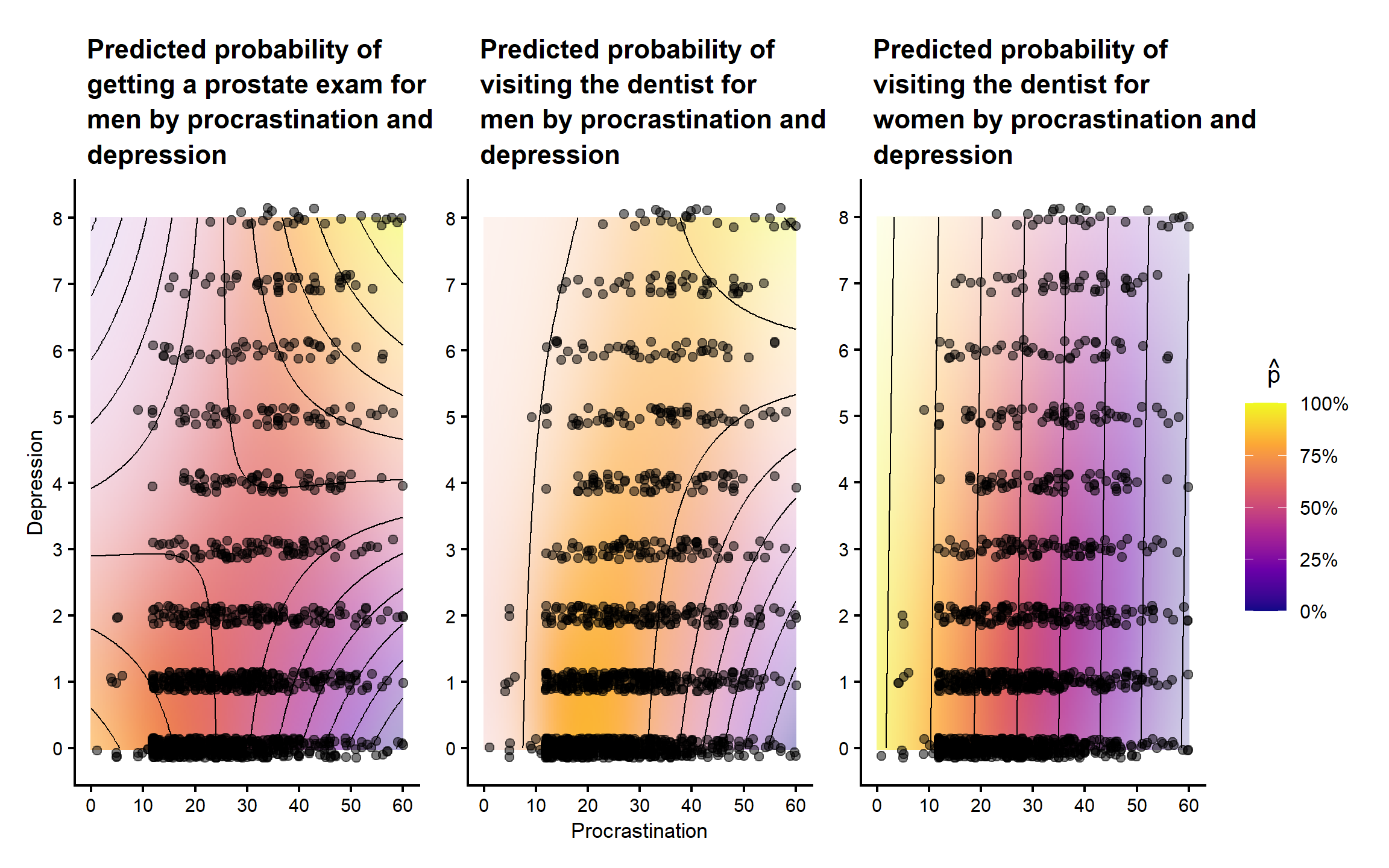
Procrastination interacted significantly with depressive symptomatology to influence prostate exam likelihood (\(\chi^2 = 11.0,\, \text{ref. df} = 3.8,\, p = 0.029\)). Specifically, higher levels of procrastination were associated with a lower probability of obtaining a prostate exam. However, the presence of depressive symptoms modified this probability with examples such as high procrastination and high depression resulting in an increased probability of undergoing the exam, whereas low procrastination coupled with high depression resulting in a decreased probability.
Similarly, procrastination interacted significantly with depression to affect dental visit likelihood in both men (\(\chi^2 = 23.0, \text{ref. df} = 5.8, p = 0.001\)) and women (\(\chi^2 = 10.0, \text{ref. df} = 3.0, p = 0.018\)). For men, higher procrastination decreased the likelihood in attending the dentist, depressive symptoms altering this likelihood. For women, both high levels of procrastination and depression would result in a decreased likelihood in attending the dentist (see Figure 1). For a breakdown of results see Table 2.
| Predictor | Gender | χ² | edf | Ref. df | p |
|---|---|---|---|---|---|
| Prostate Exam | Prostate Exam | Prostate Exam | Prostate Exam | Prostate Exam | Prostate Exam |
| Procrastination × Depression | Men | 11.0 | 3.8 | 3.8 | 0.029* |
| Mammograms | Mammograms | Mammograms | Mammograms | Mammograms | Mammograms |
| Procrastination | Women | 4.1 | 1.0 | 1.0 | 0.042* |
| Cholesterol Screenings | Cholesterol Screenings | Cholesterol Screenings | Cholesterol Screenings | Cholesterol Screenings | Cholesterol Screenings |
| Procrastination | Men | 2.2 | 1.7 | 2.1 | 0.360 |
| Procrastination | Women | 4.3 | 1.0 | 1.0 | 0.037* |
| Pap Smears | Pap Smears | Pap Smears | Pap Smears | Pap Smears | Pap Smears |
| Procrastination | Women | 1.0 | 1.0 | 1.0 | 0.330 |
| Flu Shots | Flu Shots | Flu Shots | Flu Shots | Flu Shots | Flu Shots |
| Procrastination | Men | 0.8 | 1.0 | 1.0 | 0.386 |
| Procrastination | Women | 2.1 | 1.0 | 1.0 | 0.146 |
| Dental Visits | Dental Visits | Dental Visits | Dental Visits | Dental Visits | Dental Visits |
| Procrastination × Depression | Men | 23.0 | 4.9 | 5.8 | 0.001*** |
| Procrastination × Depression | Women | 10.0 | 3.0 | 3.0 | 0.018* |
Main effects
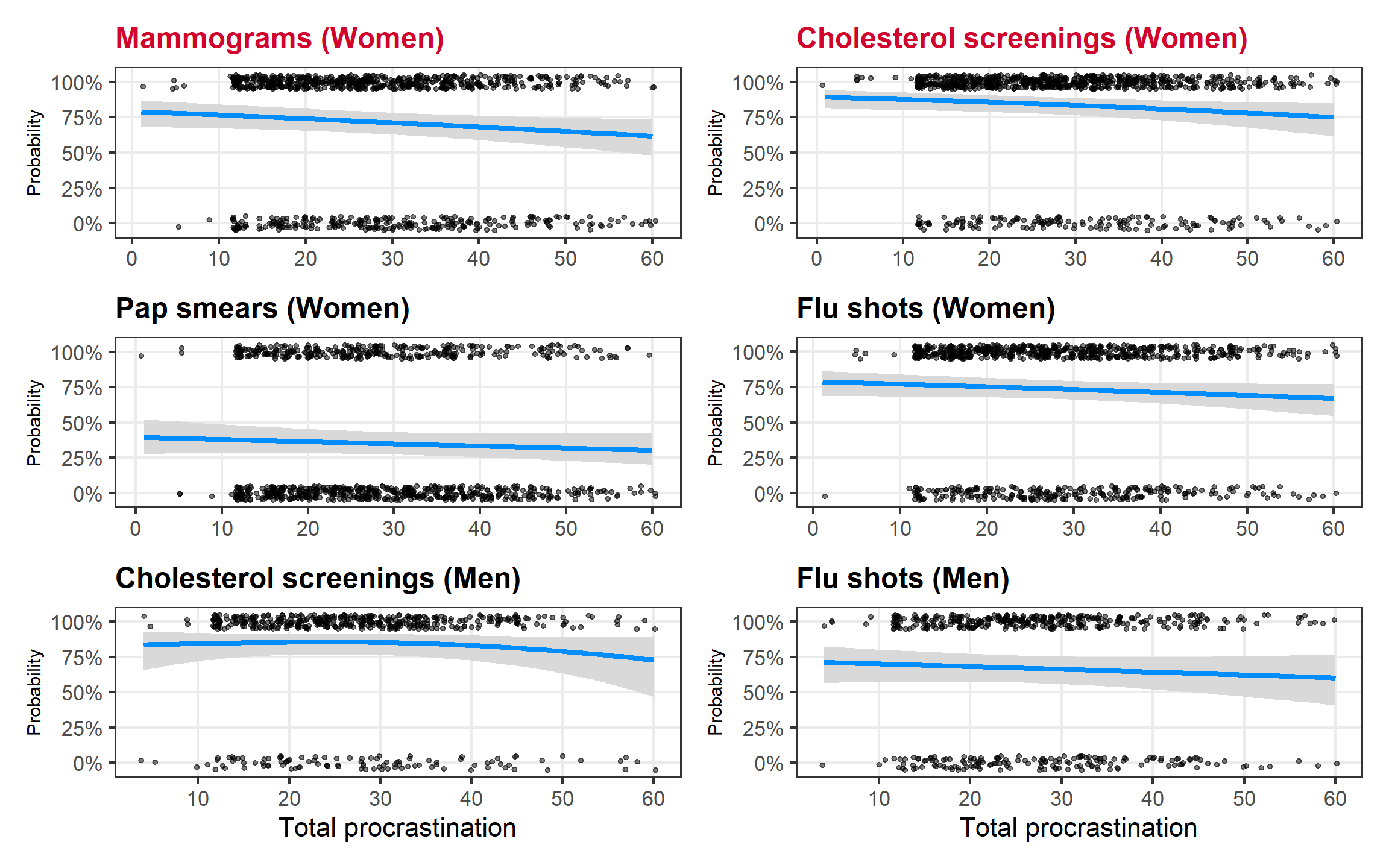
Additionally, the results of the GAM analysis revealed significant non-interacting associations for both mammograms (\(\chi^2 = 4.1, \text{ref.df} = 1.0, p = 0.042\)) cholesterol screenings (\(\chi^2 = 4.3, \text{ref.df} = 1.0, p = 0.037\)) in women (Figure 2). However, no significant effects were found for either pap smears (\(\chi^2 = 1.0, \text{ref.df} = 1.0, p = 0.330\)) and flu shots (\(\chi^2 = 2.1, \text{ref.df} = 1.0, p = 0.146\)) in women. Additionally for men, procrastination showed no association with either cholesterol screenings (\(\chi^2 = 2.2, \text{ref.df} = 2.1, p = 0.360\)) or flu shots (\(\chi^2 = 0.8, \text{ref.df} = 1.0, p = 0.386\)). A detailed breakdown of the results can be found in Table 2, with full model results in Supplementary Table S3.
Discussion
The current study aimed to extend the procrastination and health literature by investigating the association between procrastination and a range of health preventive behaviours in an older U.S. population. It was hypothesised that higher levels of procrastination would be associated with less frequent engagement in health preventive behaviors. The findings of the study support this hypothesis: among older adults, higher levels of procrastination in women only were associated with less frequent engagement in undergoing both mammograms and cholesterol screenings. Additionally, procrastination significantly interacted with depression to influence engagement in prostate exams in men and dental visits in both men and women. However, procrastination was not associated with the likelihood of undergoing a pap smear or a flu shot.
While this study is the first of our knowledge to investigate the association between procrastination and health preventive behaviours of older adults, these findings are consistent with that of previous research on younger populations (S. M. Kelly & Walton, 2021; Rapoport et al., 2024; Sirois et al., 2003, 2023; Sirois, 2007, 2017; Stead et al., 2010). Consistent with the procrastination health model (Sirois et al., 2003; Sirois, 2007), the results highlight the behavioral pathways through which procrastination impacts health. Specifically for older adults, procrastination may lead to the postponement or neglect of specific health preventive behaviours. The differences in procrastination’s impact across these behaviours may be partially explained by the complexity and structure of the tasks required to complete each screening (Anderson, 2001). Preventive behaviors that require multiple steps, such as scheduling appointments or traveling to health facilities, may provide more opportunities for procrastination compared to one-time, simple actions. Of course, it is important to consider these results in the context of policy recommendations. For instance, exploring the uptake of breast cancer screening among women aged 75+ in the U.S. may not be worthwhile, as any decrease in this age group is likely due to policy rather than individual factors like procrastination (US Preventive Services Task Force, 2024).
As mentioned, preventive behaviours play a crucial role in reducing the healthcare burden associated with chronic diseases (Bruhn, 2000). However, results from the GAM analysis revealed that older women with higher levels of procrastination were significantly less likely to undergo a mammogram, but not a pap smear. Moreover, the tensor product smooth results indicated an interplay between procrastination and depression with regard to prostate exams, as well as depression and age for pap smears. The predictive heat maps indicated that older men with higher levels of procrastination were less likely to get a prostate exam. While higher levels of depression seemed to increase this likelihood, the scarcity of data points within this region (\(n = 13\)) introduces a greater degree of uncertainty and necessitates caution due to extrapolation. Additionally, age emerges as the predominant factor in the predictive heat map for pap smears, with the probability of undergoing the procedure decreasing as age increases, regardless of depression levels.
Such results may be attributed to various factors such as, fear of the unknown, anxiety about medical procedures, financial constraints, or policy decision. The prospect of being diagnosed with a condition that has significant health implications, such as cancer can be daunting (Esbensen et al., 2008). This trepidation, coupled with the stress of confronting potentially distressing realities about one’s health, often leads individuals to defer necessary screenings (Beauregard et al., 2015; Sirois, 2015). Additionally, the costs associated with healthcare, even with insurance, can be a significant barrier for many older adults (Osborn et al., 2017). Overall, the prospect of being diagnosed with a life-altering condition such as cancer is not only emotionally stressful, but also carries with it a significant financial burden. This emotional and financial stress can exhaust the psychological resources required to effectively cope with and manage emotions, thereby exacerbating procrastination (Sirois et al., 2023). This is further compounded by policy recommendations for discontinuing certain screenings among older adults (US Preventive Services Task Force, 2018b, 2018a, 2024). However, as life expectancy increases, it becomes crucial to reassess these policies to ensure they align with the evolving needs and health profiles older adults, rather than adhering strictly to age-based criteria.
Additional results can be interpreted through a similar lens. For instance, cholesterol screenings and dental check-ups are critical components of preventive healthcare and serve as vital indicators for heart disease and oral health (Greenland et al., 2010; Thomson et al., 2010). Again, the associated stress off facing such serious health conditions can perpetuate a cycle of procrastination. Furthermore, dental health is a vital aspect of overall well-being, yet dental anxiety and the costs associated with care contribute to avoidance behaviors (Armfield et al., 2007; Rapoport et al., 2024; Steinvik et al., 2023). Procrastination in attending such screenings and checkups can result in missed opportunities for early detection and intervention, significantly increasing the risk of advanced diseases and the need for more complex treatments.
The cumulation of these stressors along with procrastination itself can also have profound psychological ramifications on older adults. Postponing or neglecting to attend health appointments or prioritize self-care can lead to an accumulation of guilt, anxiety, and stress. These emotional responses can deeply influence an individual’s self-perception. Procrastination is often associated with negative self-evaluations and self-deprecating thoughts, which can exacerbate feelings of low self-worth and hopelessness (Flett et al., 2012; McCown et al., 2012) as well as physical health decline (Osborn et al., 2017). Consequently, understanding and addressing the psychological aspects of procrastination is crucial in the holistic health management of older adults. Moreover, the complexity of preventive behaviours, scheduling, attending, and following up on the appointment, can influence the effect of procrastination. Individuals may be more likely to delay behaviors that require more effort or planning (Andersen, 2008).
Furthermore, the procrastination in preventative health behaviours not only affects individual health outcomes but also has a cascading effect on public health and healthcare expenditure. As mentioned, delaying preventive checkups can lead to the late diagnosis of diseases, which in turn are often more costly and difficult to treat (Reddy et al., 2022). Such diagnoses can result in increased morbidity and mortality rates, which in turn, place a heavier burden on healthcare systems.
Overall, the study’s findings underscore the behavioral pathways through which procrastination affects preventive health behaviours, along with the interplay that depression plays. It is important to note, however, that the preventive behaviors examined here are primarily low-frequency activities. Research into how procrastination impacts such infrequent behaviors is limited (Rapoport et al., 2024), with most studies focusing on more routine behaviors like exercise or healthy eating, which require sustained effort and may involve different motivational processes. Future research should explore how the nature and frequency of preventive behaviors influence their predictors and outcomes, as the factors driving low-frequency actions may differ from those involved in long-term behavior maintenance. Additionally, targeted interventions to reduce procrastination among older adults could improve health outcomes and ease the burden on healthcare systems. For example, simplifying appointment scheduling or offering default appointments may reduce procrastination and improve health by lessening the burden on individuals. Additionally, addressing the psychological, financial, and policy-related factors contributing to procrastination is crucial for ensuring effective care for older adults.
Limitations
Our findings are based on data from the HRS, which focuses on the health and economic dynamics of aging in the United States. The experiences of health and the impact of stress on health outcomes can vary significantly across different countries due to a multitude of factors such as cultural differences, healthcare systems, socioeconomic status, and public health policies (Hernandez & Blazer, 2006; Schoen et al., 2005). These differences can affect health care utilization independently of stress and procrastination, potentially confounding the results, if applied to international contexts. Additionally, our analyses are constrained by the questions, responses, and variables included within the HRS. As such, while this study focused on the general completion of preventive health behaviors, future research would benefit from examining the specific sub-behaviors involved in the preventive health process as such could reveal critical points where procrastination exerts its influence, particularly in the transition from intention to action.
Furthermore, repeated activation of the stress response system is a known factor linking procrastination and health behaviors (Sirois et al., 2023). However, stress was excluded from our analysis due to a high level of missingness (71%). As such, future research should include stress in their models to comprehensively understand the relationship between procrastination and health care utilization.
Conclusions
Proactive health management can significantly mitigate the risks associated with aging. For older adults, procrastination emerges as a significant risk factor that can undermine preventive health behaviors such as prostate exams, mammograms, cholesterol screenings, and dental visits. The tendency to postpone essential health-care check-ups and wellness practices can lead to increased stress and, consequently, a greater number of health issues. Given that procrastination is a modifiable behaviour the findings of this study underscore the potential benefits of reducing procrastination, not only to enhance the quality of life, but also to mitigate the risks associated with poor health and delaying preventive health behaviours.
References
Andersen, R. (2008). National health surveys and the behavioral model of health services use. Medical Care, 46(7), 647–653. https://doi.org/10.1097/MLR.0b013e31817a835d
Andersen, R., & Newman, J. F. (1973). Societal and individual determinants of medical care utilization in the united states. The Milbank Memorial Fund Quarterly. Health and Society, 95–124. https://doi.org/10.2307/3349613
Anderson, E. M. (2001). The relationships among task characteristics, self-regulation and procrastination. Loyola University Chicago.
Armfield, J. M., Stewart, J. F., & Spencer, A. J. (2007). The vicious cycle of dental fear: Exploring the interplay between oral health, service utilization and dental fear. BMC Oral Health, 7, 1–15. https://doi.org/10.1186/1472-6831-7-1
Asio, J. M. R. (2021). Procrastination and work productivity of academic staff: Implications to the institution. Online Submission, 9(1), 46–53. https://doi.org/10.34293/sijash.v9i1.4068
Bandaranayake, T., & Shaw, A. C. (2016). Host resistance and immune aging. Clinics in Geriatric Medicine, 32(3), 415–432. https://doi.org/10.1016/j.cger.2016.02.007
Beauregard, J., Ioachim, G., & Sirois, F. (2015). Trait procrastination negatively impacts coping with fibromyalgia. 9th Annual Procrastination Research Conference, Bielefeld, Germany.
Bengel, F. M., & Schwaiger, M. (2004). Assessment of cardiac sympathetic neuronal function using PET imaging. Journal of Nuclear Cardiology, 11, 603–616. https://doi.org/10.1016/j.nuclcard.2004.06.133
Beydoun, H. A., & Beydoun, M. A. (2008). Predictors of colorectal cancer screening behaviors among average-risk older adults in the united states. Cancer Causes & Control, 19, 339–359. https://doi.org/10.1007/s10552-007-9100-y
Briggs, R., Carey, D., O’Halloran, A., Kenny, R., & Kennelly, S. (2018). Validation of the 8-item centre for epidemiological studies depression scale in a cohort of community-dwelling older people: Data from the irish longitudinal study on ageing (TILDA). European Geriatric Medicine, 9, 121–126. https://doi.org/10.1007/s41999-017-0016-0
Bruhn, J. G. (2000). Delivering health care in america: A systems approach. Family & Community Health, 22(4), 79–80. https://doi.org/10.1097/00003727-200001000-00011
Clayborne, Z. M., & Colman, I. (2019). Associations between depression and health behaviour change: Findings from 8 cycles of the canadian community health survey. The Canadian Journal of Psychiatry, 64(1), 30–38. https://doi.org/10.1177/0706743718772523
Diehr, P. H., Thielke, S. M., Newman, A. B., Hirsch, C., & Tracy, R. (2013). Decline in health for older adults: Five-year change in 13 key measures of standardized health. Journals of Gerontology Series A: Biomedical Sciences and Medical Sciences, 68(9), 1059–1067. https://doi.org/10.1093/gerona/glt038
Eibich, P., & Goldzahl, L. (2021). Does retirement affect secondary preventive care use? Evidence from breast cancer screening. Economics & Human Biology, 43, 101061. https://doi.org/10.1016/j.ehb.2021.101061
Esbensen, B. A., Swane, C. E., Hallberg, I. R., & Thome, B. (2008). Being given a cancer diagnosis in old age: A phenomenological study. International Journal of Nursing Studies, 45(3), 393–405. https://doi.org/10.1016/j.ijnurstu.2006.09.004
Ferrucci, L., Giallauria, F., & Guralnik, J. M. (2008). Epidemiology of aging. Radiologic Clinics of North America, 46(4), 643–652. https://doi.org/10.1016/j.rcl.2008.07.005
Firdaus, G., Aziz, S., Akhtar, S., & Sunny, S. (2020). Young and old adults’ health-related procrastination, quality of sleep and mental wellbeing. Pakistan Journal of Physiology, 16(3), 25–28.
Flett, G. L., Stainton, M., Hewitt, P. L., Sherry, S. B., & Lay, C. (2012). Procrastination automatic thoughts as a personality construct: An analysis of the procrastinatory cognitions inventory. Journal of Rational-Emotive & Cognitive-Behavior Therapy, 30, 223–236. https://doi.org/10.1007/s10942-012-0150-z
Grad, R., Thériault, G., Singh, H., Dickinson, J. A., Szafran, O., & Bell, N. R. (2019). Age to stop?: Appropriate screening in older patients. Canadian Family Physician, 65(8), 543–548.
Greenland, P., Alpert, J. S., Beller, G. A., Benjamin, E. J., Budoff, M. J., Fayad, Z. A., Foster, E., Hlatky, M. A., Hodgson, J. M., Kushner, F. G., et al. (2010). 2010 ACCF/AHA guideline for assessment of cardiovascular risk in asymptomatic adults: A report of the american college of cardiology foundation/american heart association task force on practice guidelines developed in collaboration with the american society of echocardiography, american society of nuclear cardiology, society of atherosclerosis imaging and prevention, society for cardiovascular angiography and interventions, society of cardiovascular computed tomography, and society for cardiovascular magnetic resonance. Journal of the American College of Cardiology, 56(25), e50–e103. https://doi.org/10.1016/j.jacc.2010.09.001
Hernandez, L. M., & Blazer, D. G. (2006). The impact of social and cultural environment on health. In Genes, behavior, and the social environment: Moving beyond the nature/nurture debate. National Academies Press (US).
Hugosson, J. (2018). Stopping screening, when and how? Translational Andrology and Urology, 7(1), 46. https://doi.org/10.21037/tau.2017.12.39
Jedema, H. P., & Grace, A. A. (2004). Corticotropin-releasing hormone directly activates noradrenergic neurons of the locus ceruleus recorded in vitro. Journal of Neuroscience, 24(43), 9703–9713. https://doi.org/10.1523/JNEUROSCI.2830-04.2004
Johansson, F., Rozental, A., Edlund, K., Côté, P., Sundberg, T., Onell, C., Rudman, A., & Skillgate, E. (2023). Associations between procrastination and subsequent health outcomes among university students in sweden. JAMA Network Open, 6(1), e2249346–e2249346. https://doi.org/10.1001/jamanetworkopen.2022.49346
Juster, F. T., & Suzman, R. (1995). An overview of the health and retirement study. Journal of Human Resources, S7–S56. https://doi.org/10.2307/146277
Kelly, S. M., & Walton, H. R. (2021). “I’ll work out tomorrow”: The procrastination in exercise scale. Journal of Health Psychology, 26(13), 2613–2625. https://doi.org/10.1177/1359105320916541
Kelly, S., Martin, S., Kuhn, I., Cowan, A., Brayne, C., & Lafortune, L. (2016). Barriers and facilitators to the uptake and maintenance of healthy behaviours by people at mid-life: A rapid systematic review. PloS One, 11(1), e0145074. https://doi.org/10.1371/journal.pone.0145074
Kim, & Seo, E. H. (2015). The relationship between procrastination and academic performance: A meta-analysis. Personality and Individual Differences, 82, 26–33. https://doi.org/10.1016/j.paid.2015.02.038
Kulminski, A. M., Ukraintseva, S. V., Akushevich, I. V., Arbeev, K. G., & Yashin, A. I. (2007). Cumulative index of health deficiencies as a characteristic of long life. Journal of the American Geriatrics Society, 55(6), 935–940. https://doi.org/10.1111/j.1532-5415.2007.01155.x
McCown, B., Blake, I. K., & Keiser, R. (2012). Content analyses of the beliefs of academic procrastinators. Journal of Rational-Emotive & Cognitive-Behavior Therapy, 30, 213–222. https://doi.org/10.1007/s10942-012-0148-6
Monaghan, C., Avila-Palencia, I., Han, S. D., & McHugh Power, J. (2024). Procrastination, depressive symptomatology, and loneliness in later life. Aging & Mental Health, 1–8. https://doi.org/10.1080/13607863.2024.2345781
Osborn, R., Doty, M. M., Moulds, D., Sarnak, D. O., & Shah, A. (2017). Older americans were sicker and faced more financial barriers to health care than counterparts in other countries. Health Affairs, 36(12), 2123–2132. https://doi.org/10.1377/hlthaff.2017.1048
R Core Team, R. (2013). R: A language and environment for statistical computing.
Rapoport, O., Möcklinghoff, S., Merz, S., & Neidhardt, E. (2024). " can i please postpone my dentist appointment?"-exploring a new area of procrastination. Current Psychology, 43(5), 4526–4535. https://doi.org/10.1007/s12144-023-04598-x
Rawla, P. (2019). Epidemiology of prostate cancer. World Journal of Oncology, 10(2), 63. https://doi.org/10.14740/wjon1191
Reddy, S. R., Broder, M. S., Chang, E., Paydar, C., Chung, K. C., & Kansal, A. R. (2022). Cost of cancer management by stage at diagnosis among medicare beneficiaries. Current Medical Research and Opinion, 38(8), 1285–1294. https://doi.org/10.1080/03007995.2022.2047536
Schoen, C., Osborn, R., Huynh, P. T., Doty, M., Zapert, K., Peugh, J., & Davis, K. (2005). Taking the pulse of health care systems: Experiences of patients with health problems in six countries: Patients’ voices can provide policy leaders with a window onto what is happening at the front lines of care. Health Affairs, 24(Suppl1), W5–509. https://doi.org/10.1377/hlthaff.W5.509
Shi, X., Wang, S., Liu, S., Zhang, T., Chen, S., & Cai, Y. (2019). Are procrastinators psychologically healthy? Association between psychosocial problems and procrastination among college students in shanghai, china: A syndemic approach. Psychology, Health & Medicine, 24(5), 570–577. https://doi.org/10.1080/13548506.2018.1546017
Shimamura, M., Matsuyama, Y., Morita, A., & Fujiwara, T. (2022). Association between procrastination in childhood and the number of remaining teeth in japanese older adults. Journal of Epidemiology, 32(10), 464–468. https://doi.org/10.2188/jea.JE20200366
Sirois, F. M. (2007). “I’ll look after my health, later”: A replication and extension of the procrastination–health model with community-dwelling adults. Personality and Individual Differences, 43(1), 15–26. https://doi.org/10.1016/j.paid.2006.11.003
Sirois, F. M. (2014). Procrastination and stress: Exploring the role of self-compassion. Self and Identity, 13(2), 128–145. https://doi.org/10.1080/15298868.2013.763404
Sirois, F. M. (2015). Is procrastination a vulnerability factor for hypertension and cardiovascular disease? Testing an extension of the procrastination–health model. Journal of Behavioral Medicine, 38, 578–589. https://doi.org/10.1007/s10865-015-9629-2
Sirois, F. M. (2017). Procrastination, health, and health risk communication. In Oxford research encyclopedia of communication. https://doi.org/10.1093/acrefore/9780190228613.013.345
Sirois, F. M., Melia-Gordon, M. L., & Pychyl, T. A. (2003). “I’ll look after my health, later”: An investigation of procrastination and health. Personality and Individual Differences, 35(5), 1167–1184. https://doi.org/10.1016/S0191-8869(02)00326-4
Sirois, F. M., & Pychyl, T. A. (2016a). Future of research on procrastination, health, and well-being: Key themes and recommendations. In Procrastination, health, and well-being (pp. 255–271). Elsevier. https://doi.org/10.1016/B978-0-12-802862-9.00012-8
Sirois, F. M., & Pychyl, T. A. (2016b). Procrastination, health, and well-being. Academic Press.
Sirois, F. M., Stride, C. B., & Pychyl, T. A. (2023). Procrastination and health: A longitudinal test of the roles of stress and health behaviours. British Journal of Health Psychology, 28(3), 860–875. https://doi.org/10.1111/bjhp.12658
Stead, R., Shanahan, M. J., & Neufeld, R. W. (2010). “I’ll go to therapy, eventually”: Procrastination, stress and mental health. Personality and Individual Differences, 49(3), 175–180. https://doi.org/10.1016/j.paid.2010.03.028
Steel, P. (2007). The nature of procrastination: A meta-analytic and theoretical review of quintessential self-regulatory failure. Psychological Bulletin, 133(1), 65. https://doi.org/10.1037/0033-2909.133.1.65
Steel, P. (2010). Arousal, avoidant and decisional procrastinators: Do they exist? Personality and Individual Differences, 48(8), 926–934. https://doi.org/10.1016/j.paid.2010.02.025
Steinvik, L. M., Svartdal, F., & Johnsen, J.-A. K. (2023). Delay of dental care: An exploratory study of procrastination, dental attendance, and self-reported oral health. Dentistry Journal, 11(2), 56. https://doi.org/10.3390/dj11020056
Stephens, M. A. C., & Wand, G. (2012). Stress and the HPA axis: Role of glucocorticoids in alcohol dependence. Alcohol Research: Current Reviews, 34(4), 468.
Sun, Y.-S., Zhao, Z., Yang, Z.-N., Xu, F., Lu, H.-J., Zhu, Z.-Y., Shi, W., Jiang, J., Yao, P.-P., & Zhu, H.-P. (2017). Risk factors and preventions of breast cancer. International Journal of Biological Sciences, 13(11), 1387. https://doi.org/10.7150/ijbs.21635
The International Agency for Research on Cancer. (2024). Global cancer observatory. https://gco.iarc.fr/
Thomson, W., Williams, S., Broadbent, J., Poulton, R., & Locker, D. (2010). Long-term dental visiting patterns and adult oral health. Journal of Dental Research, 89(3), 307–311. https://doi.org/10.1177/0022034509356779
Tice, D. M., & Baumeister, R. F. (1997). Longitudinal study of procrastination, performance, stress, and health: The costs and benefits of dawdling. Psychological Science, 8(6), 454–458. https://doi.org/10.1111/j.1467-9280.1997.tb00460.x
Turk, D. C., & Meichenbaum, D. (1991). Adherence to self-care regimens: The patient’s perspective. In Handbook of clinical psychology in medical settings (pp. 249–266). Springer. https://doi.org/10.1007/978-1-4615-3792-2_15
US Preventive Services Task Force. (2018a). Screening for Cervical Cancer: US Preventive Services Task Force Recommendation Statement. JAMA, 320(7), 674–686. https://doi.org/10.1001/jama.2018.10897
US Preventive Services Task Force. (2018b). Screening for Prostate Cancer: US Preventive Services Task Force Recommendation Statement. 319(19), 1901–1913. https://doi.org/10.1001/jama.2018.3710
US Preventive Services Task Force. (2024). Screening for Breast Cancer: US Preventive Services Task Force Recommendation Statement. JAMA. https://doi.org/10.1001/jama.2024.5534
Veazie, P., & Denham, A. (2021). Understanding how psychosocial factors relate to seeking medical care among older adults using a new model of care seeking. Social Science & Medicine, 281, 114113. https://doi.org/10.1016/j.socscimed.2021.114113
Werle, C. (2011). The determinants of preventive health behavior: Literature review and research perspectives. Hal: Archive-Ouvertes.
Wood, S. N. (2017). Generalized additive models: An introduction with r. chapman; hall/CRC. https://doi.org/10.1201/9781315370279
Open access statement
In the spirit of open science I try to keep as much of my research freely available online as possible. With that in mind all code and materials related to this project can be found below.