
Procrastination as a Social Norm Violation: The Role of Domain and Age in Evaluative Judgments
Abstract
Although often conceptualised as an individual self-regulatory failure, procrastination may also function as a social norm violation by conflicting with expectations surrounding productivity, responsibility, and self-regulation. The present study examined whether evaluations of procrastination vary across behavioural domains and age groups. Using a mixed-factorial experimental design, 200 UK adults (18–30 years; 60+ years) recruited through Prolific were randomly assigned to evaluate either procrastination or non-procrastination vignettes across three domains: general, health, and financial. Participants rated each vignette using a negative productivity index and four bipolar adjective pairs reflecting social and self-evaluative judgments. Financial procrastination was judged as more negatively productive and more shameful than general procrastination, while health procrastination was evaluated as more negatively productive and more self-critical than general procrastination. Contrary to expectations, there was little evidence that age moderated these domain-specific evaluations. Overall, the findings indicate that procrastination is perceived as a social norm violation, but that the severity of this evaluation depends on the domain in which the behaviour occurs.
CautionThis chapter of my thesis is part of a broader set of research projects that is still in writing.
Introduction
Procrastination involves the voluntary delay of an intended course of action despite expecting negative consequences (Klingsieck, 2013; Steel, 2007). Although often conceptualised as an individual self-regulatory failure, procrastination also has important interpersonal and social dimensions (J. R. Ferrari et al., 1998; Giguère et al., 2016). Procrastination frequently occurs in socially embedded contexts such as education, employment, and health management (Abbasi & Alghamdi, 2015; Sirois, 2007), where performance is observable and carries implications for others. Consequently, delays in these settings can carry interpersonal implications that extend beyond the individual, shaping how others evaluate the appropriateness, reliability, and responsibility of one’s behaviour (Giguère et al., 2016).
One framework for understanding these evaluations is social norms. Social norms are cognitive representations of how others would typically think, feel, or act in a given situation (Giguère et al., 2016). Social norms are oftentimes seen as unwritten rules or expectations. Examples include, saying “please” and “thank you”, returning shopping carts, or queuing in lines. However, social norms are not universal and can vary substantially across cultures, social groups, and contexts (Chen-Xia et al., 2023; Filippidis et al., 2026). Behaviours that are considered normative in one setting may be less expected or even absent in another. For instance, norms surrounding queuing in lines or standing on a particular side of an escalator may be more strongly enforced in one country but not another (Filippidis et al., 2026). As such, social norms are not fixed behavioural rules, but rather context-dependent. Nevertheless, across contexts, social norms play a fundamental role in shaping human behaviour by providing standards against which actions are evaluated.
Social norms influence behaviour through several interrelated mechanisms. One important mechanism is social comparison (Giguère et al., 2016). Social comparison theory (Festinger, 1954) posits that individuals evaluate their own behaviour relative to that of others, using perceived norms as benchmarks for what is appropriate. However, norm adherence is not solely driven by comparative processes. They also operate through broader regulatory mechanisms, including perceptions of what most people do (i.e., descriptive norms) and perceptions of what most people approve of (i.e., injunctive norms) (Cialdini et al., 1990; Cialdini & Trost, 1998). Taken together, these processes motivate individuals to align their behaviour with group expectations in order to avoid social disapproval (Cialdini & Trost, 1998). Consequently, behaviours which fall outside these norms are more likely to be noticed and may be perceived as socially incongruent.
Within this framework, procrastination can be conceptualised as a behaviour that frequently violates social norms. Delaying important tasks often conflicts with widely endorsed expectations surrounding productivity, reliability, and effective self-regulation. However, not all forms of procrastination are equally socially consequential. Norm-based evaluations are most likely to arise in situations where delays disrupt interpersonal expectations or have implications for others (Giguère et al., 2016). For example, an individual who delays completing a work assignment until after the deadline, despite having sufficient time to do so, may be perceived not only as inefficient but also as inconsiderate or unreliable if their delay affects colleagues or collaborators. Over time, repeated violations of such interpersonal expectations may contribute to negative social evaluations and social devaluation by others (J. R. Ferrari et al., 1998; Giguère et al., 2016; Schouwenburg & Lay, 1995).
However, the perception and evaluation of these norm violations are unlikely to be uniform across individuals or cultures and may vary across the lifespan. Younger adults tend to be more responsive to social comparison processes and peer-based evaluation (Koppenborg & Klingsieck, 2022; Nordby et al., 2017). Moreover, procrastination frequently occurs in contexts such as education and early career development (Abbasi & Alghamdi, 2015; Koppenborg & Klingsieck, 2022), where performance and competence are highly visible to others (Bursztyn & Jensen, 2015). As a result, procrastinatory behaviours may be particularly likely to attract social scrutiny among younger adults and consequently carry greater evaluative significance.
In contrast, later life is generally characterised by a more stable sense of self and age-related shifts in motivational priorities (Buunk et al., 2020). According to Socioemotional Selectivity Theory, as we age we increasingly prioritise emotionally meaningful goals and long-term well-being (Carstensen, 2001). Consequently, evaluations of procrastination may become less influenced by peer-based comparison and more influenced by the perceived consequences of delay. This suggests that age differences in evaluations of procrastination may be particularly evident across domains that differ in their relevance to long-term well-being.
These considerations suggest that the relationship between social norms and procrastination is inherently domain-specific. While much research has focused on “general procrastination”, procrastination is particularly consequential within the health (Johansson et al., 2023; Monaghan et al., 2025; Sirois et al., 2003; Sirois, 2007; Sirois et al., 2023) and financial (Brown & Previtero, 2014; Gamst-Klaussen et al., 2019; Shah & Mukherjee, 2025) domains, where delays can carry meaningful and often long-term consequences. For instance, procrastinating health screenings could result in undetected issues increasing in severity, especially as we get older (Monaghan et al., 2025). Importantly, each of these domains are embedded within distinct normative contexts. In general task contexts, norms emphasising productivity and timely completion are reinforced through social expectations and peer-based evaluation (Cialdini et al., 1990). In contrast, health-related behaviours are guided by social norms that emphasise self-care and taking care of one’s health for the future (Ball et al., 2010; Dean & Kickbusch, 1995), while financial behaviours are shaped by norms surrounding personal responsibility (Samuel et al., 2023).
Beyond shaping the domains that individuals prioritise, age-related differences in social comparison and motivational processes may also influence the overall evaluation of procrastination. Younger adults are generally more sensitive to peer evaluation and social comparison (Koppenborg & Klingsieck, 2022; Nordby et al., 2017), whereas older adults tend to report greater emotional regulation and self-compassion (Buunk et al., 2020; Carstensen, 2001). Consequently, procrastination may carry different psychological meanings across age groups, even when it occurs in the same context. Younger adults may be more likely to interpret procrastination as reflecting some form of personal inadequacy or failure, whereas older adults may adopt a less self-critical perspective.
Building on this framework, we propose that procrastination is not uniformly perceived as a norm violation, but that its evaluation depends jointly on the domain in which it occurs and the age of the individual evaluating the behaviour. Specifically, we expect procrastination to be i) evaluated more negatively in domains associated with long-term responsibility and consequential outcomes (i.e., health and finance) than in more general task contexts. Furthermore, we expect that ii) these domain effects will be moderated by age, such that older adults will judge both health and financial procrastination more harshly than younger adults. Finally, we expect that iii) in general older adults and younger adults will differ in their evaluations of the procrastination scenarios.
Methods
Study design
This study employed a mixed-factorial experimental design to elicit norms relating to traits across three life domains (general, health, financial). Specifically, the norms were elicited using vignettes to enable participants to imagine themselves as either a procrastinator or a non-procrastinator. The full text of all vignettes is provided in the Appendix. The study employed a 2 (vignette condition: procrastination vs. non-procrastination; between-subjects) × 2 (age group: younger adults \(18 - 30\) vs. older adults \(60+\); between-subjects) × 3 (domain: general, health, financial; within-subjects) mixed factorial design.
Participants were randomly assigned to read either the procrastination or non-procrastination vignettes, with allocation balanced across conditions (vignette condition, age group, and gender). Each participant read the three vignettes in order to facilitate within-person comparisons of the ratings of each of the three domains. The general vignette was always presented first, while the health and financial vignettes were then presented in randomized order to control for sequence effects. Additionally, two attention checks (i.e., “please select strongly agree”) were randomly presented within the study to ensure data quality. Participants remained blind to the study’s hypotheses and to the between-subjects manipulation (i.e., age).
Participants
Data were collected via the crowdsourcing platform Prolific, targeting two age groups of UK-based adults: younger adults (18–30 years) and older adults (60+ years). A total of 200 participants were recruited, yielding 600 vignette evaluations (3 evaluations per participant). Of these 200 participants \(51\% \; (n = 101)\) were female. Participants were compensated £2 for on average 10 minutes of participation, consistent with Prolific’s fair payment guidelines.
Participants who failed the attention checks or had excessive missing data (i.e., \(> 80\%\) missing) were excluded from analyses and additional participants were gathered until the target quota was met. Ethical approval for the study was obtained from Institutional Research Ethics Boards at Durham University.
Materials and procedure
Vignette stimuli
Participants were presented with three short, domain-specific vignettes wherein they were instructed to imagine themselves as the type of person described in the vignettes. In the procrastination condition, participants imagined themselves as someone who often unnecessarily delays important tasks despite negative consequences. In the non-procrastination condition, they imagined themselves as someone who rarely delays tasks and typically acts promptly. Each vignette included realistic examples (e.g., booking a medical check-up or paying a bill) to encourage vivid and self-relevant mental simulation. Following the presentation of each vignette, participants were first asked to rate how in the scenario (\(1\) = very easy; \(5\) = very difficult) and secondly asked to self-rate how using a set of bi-polar adjectives (described below). The verbatim for each of the vignettes is presented in the Appendix.
Data analysis
All data analysis was carried in R (R Core Team, 2025). Given that multiple vignette ratings were nested within participants, we used multilevel models with random intercepts included to account for within-participant variability. Let \(i = 1, \dots, N\) represent participants and \(j = 1, \dots, n_i\) represent observations within participant. For each outcome, the linear predictor was defined as:
\[\eta_{ij} = \mathbf{x}_{ij}^\top \boldsymbol{\beta} + u_i\]
where \(\mathbf{x}_{ij}\) is a vector of fixed-effect predictors (in this case, vignette scenario, vignette domain, and age group), \(\boldsymbol{\beta}\) is the corresponding vector of regression coefficients, and \(u_i \sim \mathcal{N}(0, \sigma^2_u)\) represents participant-specific random intercepts.
Outcome 1: Negative productivity index
The negative productivity index was measured by averaging six of the adjective pairs and as such was on a continuous scale bounded between 1 – 7. Because standard linear models assume unbounded normally distributed residuals, applying a Gaussian model to bounded data may lead to biased estimates and spurious predictions (S. Ferrari & Cribari-Neto, 2004). To address this, the index was rescaled to an open unit interval \((y_{ij} \in \{0, 1\})\) and modelled using a beta distribution, with the glmmTMB package (McGillycuddy et al., 2025). Such formulation allows for both the modelling of the mean \(\mu_{ij}\) and dispersion \(\phi_{ij}\) such that:
\[\begin{aligned} y_{ij} &\sim \text{Beta}(\mu_{ij}, \phi_{ij}) \\[2pt] \text{logit}(\mu_{ij}) &\sim \eta_{ij} \\[2pt] \log(\phi_{ij}) &= \pmb{z}_{ij}^\top \pmb{\gamma} \end{aligned}\]
where \(\pmb{z}_{ij}\) is a vector of predictors and \(\pmb{\gamma}\) are dispersion parameters.
Outcome 2: Adjective ratings
In contrast, the individual adjectives were measured on an ordinal Likert scale ranging from 1 – 7. Rather than treating these ordinal responses as continuous, cumulative link mixed models were fitted using the ordinal package (Christensen, 2025), which appropriately accounts for the ordered nature of the data without assuming equal spacing between scale points. Let \(Y_{ij} \in \{1, \dots, 7\}\) denote the ordinal response. A cumulative link mixed model was specified such that:
\[\Pr(Y_{ij} \leq k) = \text{logit}^{-1}(\theta_k - \eta_{ij}), \quad k = 1, \dots, 6\]
where \(\theta_k\) are ordered threshold parameters.
Model interpretation and follow-up analyses
To facilitate interpretation, estimated marginal means and pairwise contrasts were derived from the fitted models using the emmeans package (Lenth & Piaskowski, 2026). Additionally, to account for the multiple comparisons, all resulting p-values were adjusted using a Hochberg correction (Chen et al., 2017).
For the negative productivity index (beta regression model) both the estimated marginal means and resulting pairwise contrasts were likewise computed on the response scale, allowing for the effects to be interpreted as differences in predicted scores between conditions. For the cumulative link models, estimated marginal means and resulting pairwise contrasts were back-transformed from the logit scale to the original 1 – 7 response scale. As such, reported values represent predicted mean ratings and differences on the original Likert scale.
Results
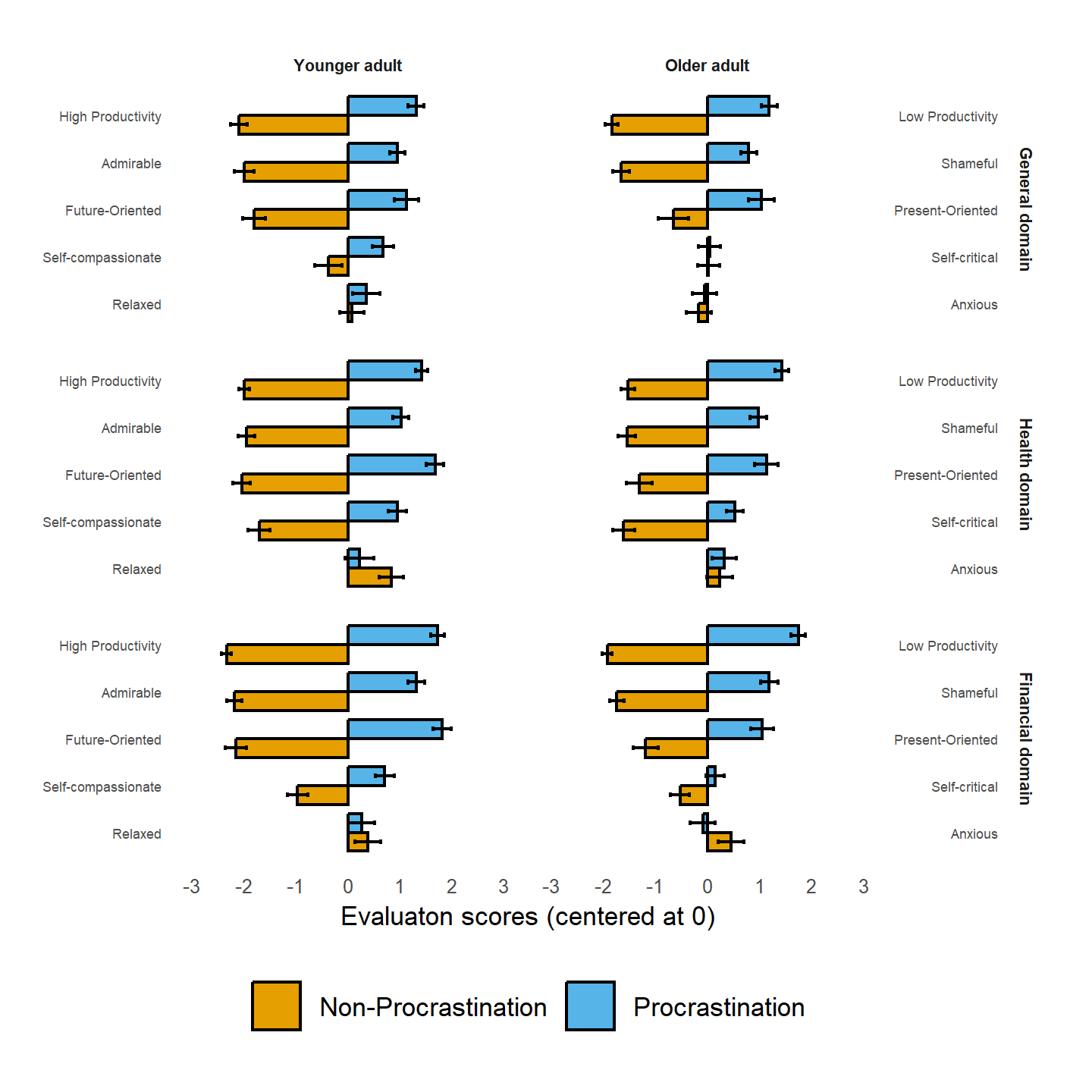
Participants \((N = 200)\) were evenly distributed across age groups, with \(100\) younger adults and \(100\) older adults. The mean age for the younger adults was \((M = 24.49; SD = 3.49)\) while for older adults the mean age was \((M = 65.10; SD = 4.53)\). Additionally, mean ratings for both the negative productivity index and individual adjective pairs are presented in Figure 1. Finally, full demographic information for the study sample is presented in Table A1.
Negative productivity index
The negative productivity index was analysed using a beta mixed-effects regression model with a logit link function. The model included three factors: scenario (procrastination and non-procrastination), domain (general, health, and financial), and age group (younger adult and older adult). Likelihood ratio tests indicated that including both the scenario × domain interaction, \((\chi^2(2) = 42.30; p < .001)\), and the scenario × age group interaction, \((\chi^2(1) = 7.79; p = .005)\), significantly improved model fit, whereas the domain × age group interaction did not (\(\chi^2(2) = 0.99; p = .63\)). Full model results are presented in Table A2.
H1: Domain differences in evaluations of procrastination
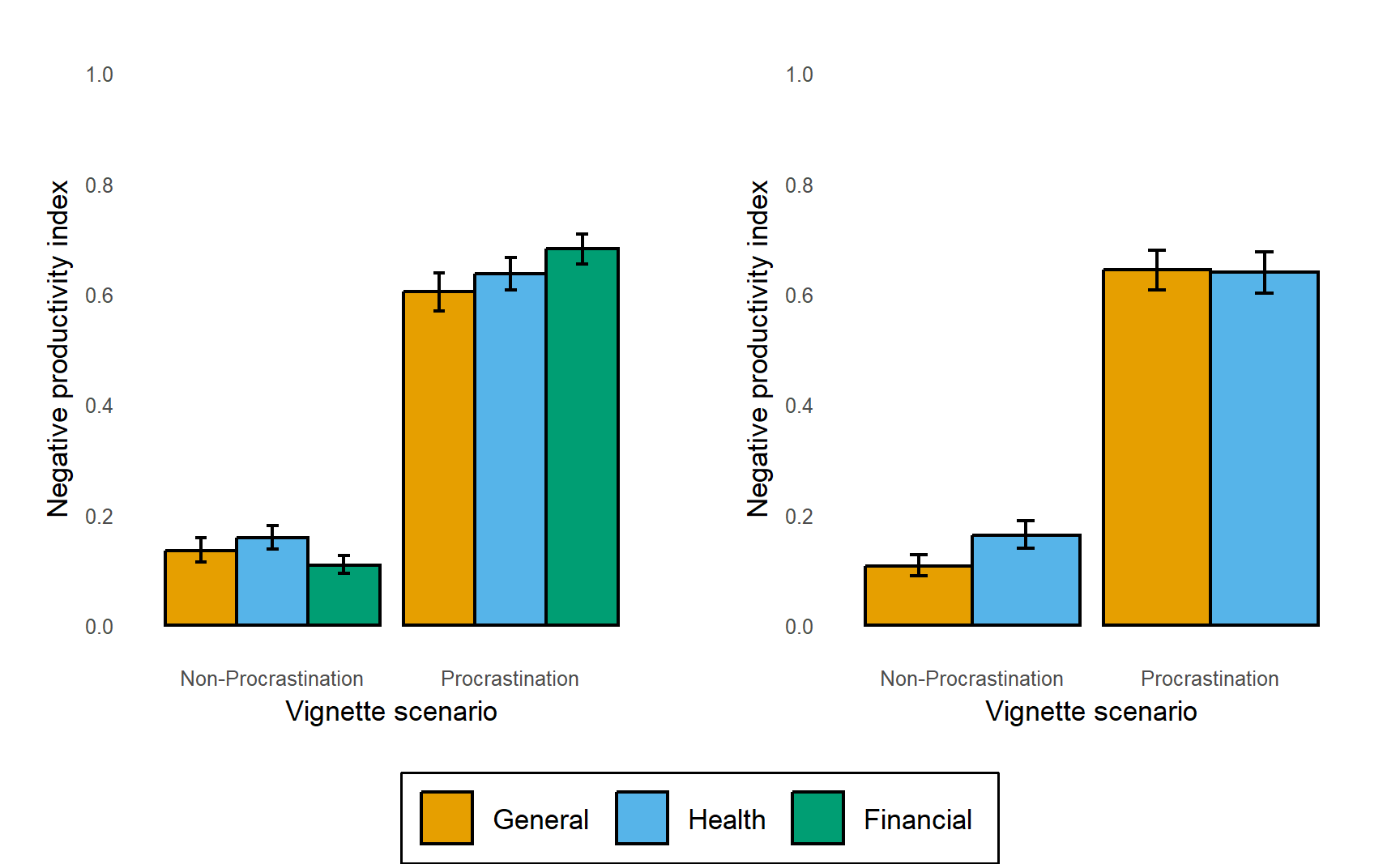
The results for the negative productivity index were consistent with our hypothesis that domain differences would be present between both the procrastination and non-procrastination scenarios (see Figure 2). Within the non-procrastination scenarios, negative productivity evaluations were generally low across all domains. Within this scenario, the financial domain (\(M = 0.11\) [0.09; 0.13]) was associated with lower perceived negative productivity than both the general (\(M = 0.13\) [0.11; 0.16]; \(p = .026\)) and health (\(M = 0.16\) [0.14; 0.18]; \(p < .001\)) domains. Additionally, the health domain was rated slightly more negatively than the general domain (\(p = .048\)).
More importantly, in the procrastination scenario, negative productivity evaluations were substantially higher across all domains. Procrastination in the financial domain (\(M = 0.68\) [0.65; 0.71]) was associated with the highest levels of negative productivity, exceeding both the general (\(M = 0.60\) [0.57; 0.63]; \(p < .001\)) and slightly the health (\(M = 0.64\) [0.61; 0.67]; \(p = .001\)) domains. Similarly, procrastination in the health domain was evaluated as more negatively productive than the general domain (\(p = .034\)).
Adjective ratings
Each of the four individual adjective pairs were analysed using a cumulative link mixed model. Similar to the negative productivity index, the model included three factors: scenario (procrastination and non-procrastination), domain (general, health, and financial), and age group (younger adult and older adult). For all adjectives pairs (except relaxed - anxious) likelihood ratio tests indicated that both the scenario × domain interaction \((\chi^2(2) \in \{9.68 - 71.37\}; p < 0.001)\) and the scenario × age group interaction \((\chi^2(2) \in \{4.00 - 13.74\}; p \in \{0.0002 - 0.045\})\) significantly improved model fit, whereas the domain × age group did not \((\chi^2(2) \in \{0.21 - 3.44\}; p \in \{0.179 - 0.912\})\). For the relaxed - anxious adjective pair, none of the interaction terms improved the model fit, and while an additive model was retained for interpretation, none of the adjective results were in line with our hypotheses. Full model results are presented in Table A3
H1: Domain differences in evaluations of procrastination
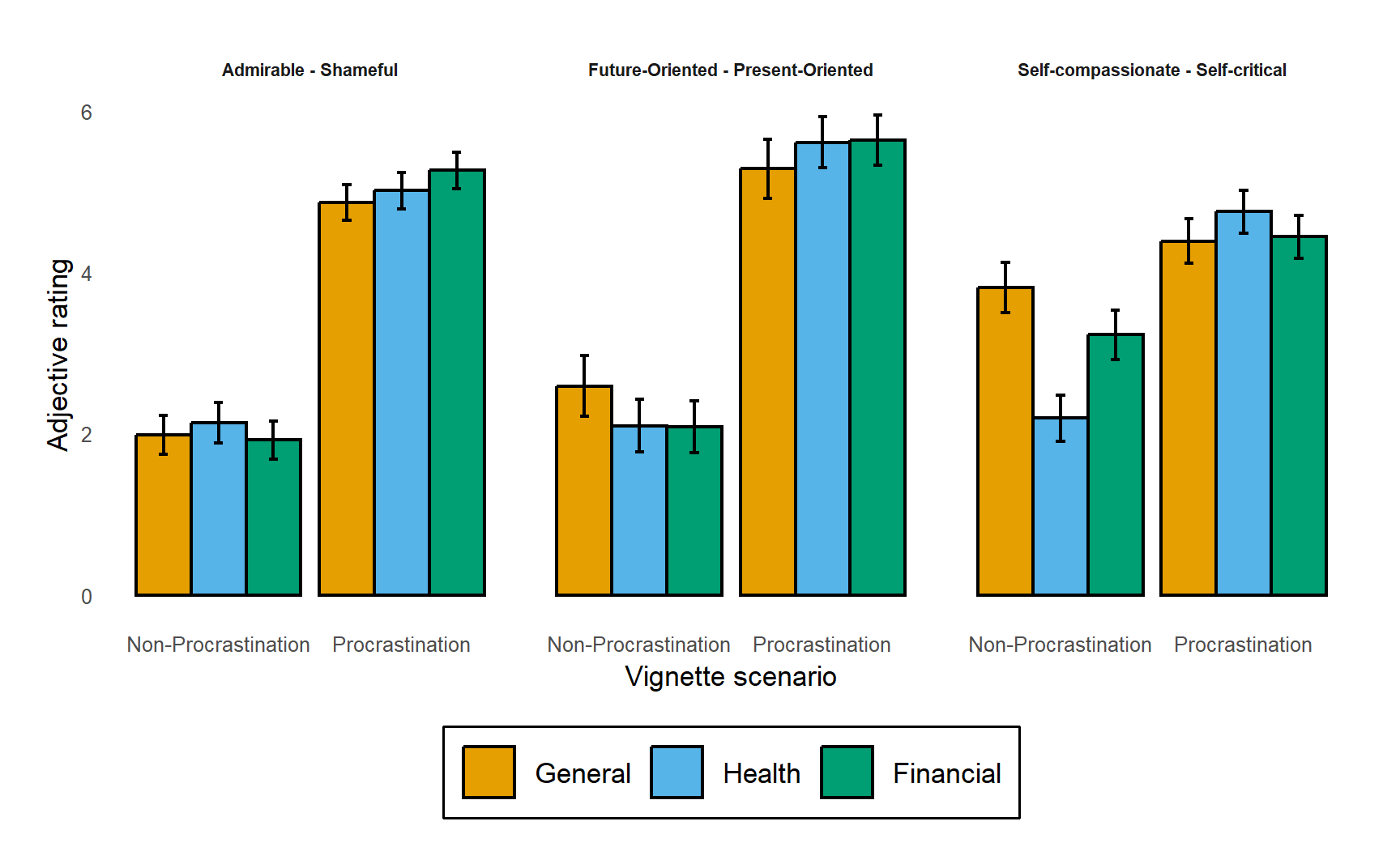
For several of the adjective pairs, significant domain effects were present depending on whether participants evaluated a procrastination or non-procrastination scenario (see Figure 3).
For the admirable – shameful adjective, non-procrastination scenarios were rated as uniformly admirable across domains (all \(p \ge .244\)). In contrast, the procrastination scenarios were rated as substantially more “shameful”, with the financial domain receiving the most negative evaluations (\(M = 5.26\) [5.03; 5.49]), followed by the health (\(M = 5.01\) [4.79; 5.24]), and general (\(M = 4.86\) [4.64; 5.09]) domain. Pairwise comparisons of the marginal means indicated that financial contexts were evaluated significantly more shamefully than general contexts (\(p = .001\)), with a marginal difference between financial and health contexts (\(p = .050\)).
Results for the future-oriented – present-oriented adjective provided weaker evidence for domain specific evaluations. Within the non-procrastination scenarios, both health (\(M = 2.10\) [1.77, 2.42]) and financial (\(M = 2.08\) [1.76, 2.42]) domains were rated as significantly more “future-oriented” than in the general domain (\(M = 2.59\) [2.22, 2.97]; both \(p = .011\)). In contrast, no significant differences (all \(p \ge 0.083\)) were noted in the procrastination scenarios with the general \((M = 5.28 \; [4.92 - 5.65])\), health \((M = 5.61 \; [5.30 - 5.92])\) and financial \((M = 5.64 \; [5.33 - 5.95])\) domains being rated similarly.
For the self-compassionate – self-critical adjective, the results for the non-procrastination scenarios indicated the health domain was associated with the most “self-compassionate” evaluation (\(M = 2.19\) [1.19; 2.48]), followed by the financial (\(M = 3.32\) [2.92; 3.53]) and general (\(M = 3.81\) [3.50; 4.12]) domains. Subsequent pairwise comparisons of the marginal means indicated that all the domains significantly differed from one another (all \(p < 0.001\)). In contrast, for the procrastination scenarios, the health domain was associated with the most “self-critical” evaluations (\(M = 4.75\) [4.49; 5.02]), followed by the financial (\(M = 4.44\) [4.18; 4.71]) and general (\(M = 4.39\) [4.11; 4.66]) domains. Pairwise comparisons indicated that health domain was evaluated as significantly more self-critical than general contexts \((p = 0.043)\), whereas differences between financial and general \((p = 0.703)\) and between financial and health domains \((p = 0.067)\) were both not significant.
Overall, the strongest domain-specific differences were present for both the evaluations of “shamefulness” and “self-criticism”, with procrastination in the financial and health domains generally receiving more negative evaluations than procrastination in the general domain.
H2: Age differences in domain evaluations of procrastination
Similar to the negative productivity index, there was little evidence that adjective evaluations of each procrastination domain differed between younger and older adults. As mentioned, the likelihood ratio tests indicated that the domain × age group interaction had no significant effect within the model and inspection of the model results revealed non-significant effects for all domains (see Table A3).
H3: Age differences in evaluations of procrastination
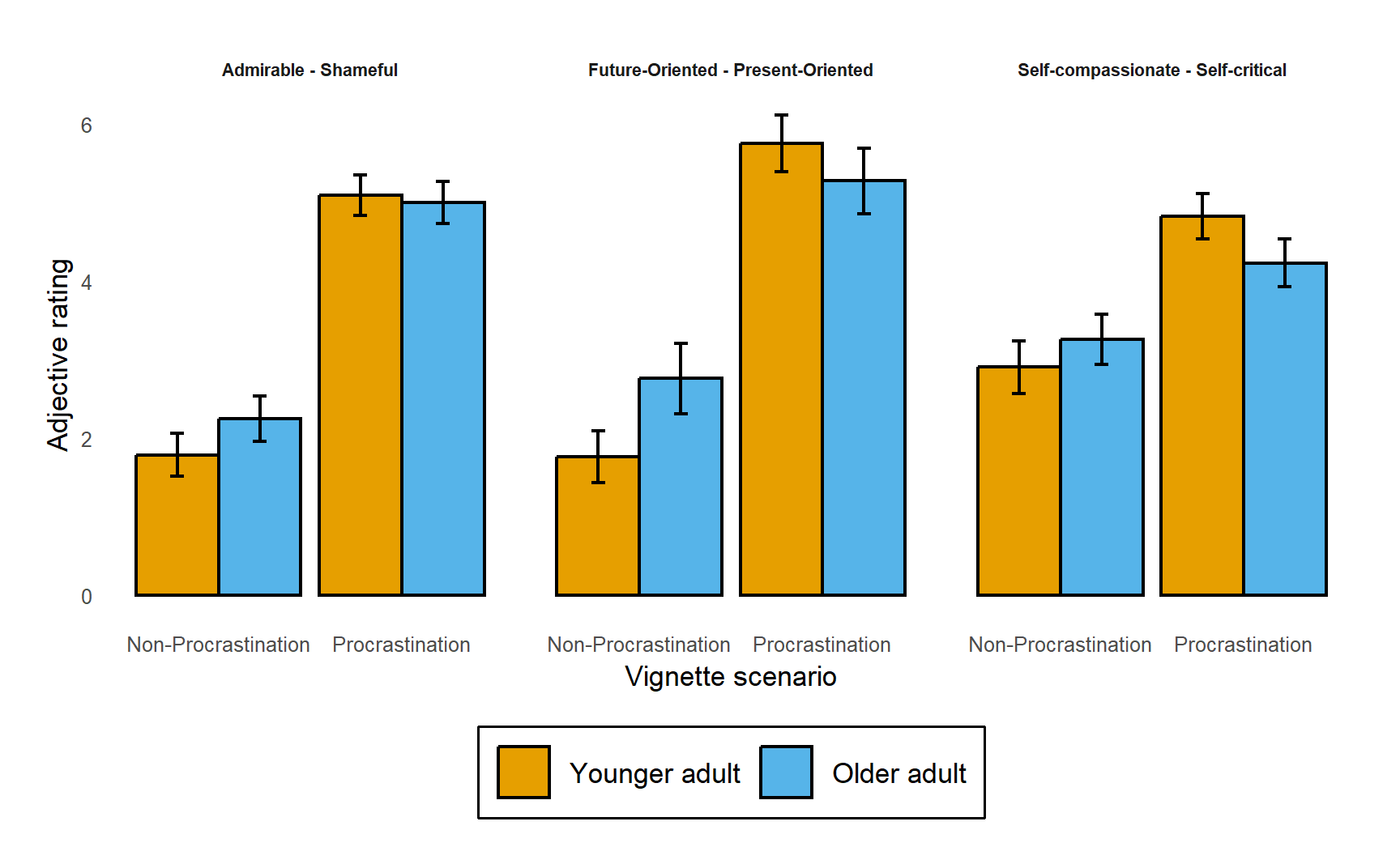
With regard to our hypothesis that age differences would be present in the overall evaluations of procrastination, there was weak evidence present for differences between younger and older adults (see Table A3 and Figure 4).
For the admirable – shameful adjective, younger adults evaluated the non-procrastination scenarios as more “admirable” than older adults (\(M = 1.79\) [1.51, 2.06] vs. \(M = 2.24\) [1.96, 2.53]; \(p = .024\)). However, no age differences were observed between younger and older adults when evaluating the procrastination scenarios (\(M = 5.09\) [4.83, 5.35] vs. \(M = 5.00\) [4.73, 5.27]; \(p = .631\)).
A similar set of results were noted for the future-oriented – present-oriented adjective. Younger adults evaluated the non-procrastination scenarios as more “future-oriented” than older adults (\(M = 1.76\) [1.43, 2.09] vs. \(M = 2.76\) [2.31, 3.21]; \(p < .001\)). Again, no such differences were noted in the procrastination scenarios with younger and older adults reporting similar evaluations (\(M = 5.75\) [5.39, 6.11] vs. \(M = 5.27\) [4.86, 5.69]; \(p = .089\)).
For the self-compassionate – self-critical adjective, no such age differences were noted between younger and older adults in the non-procrastination scenario (\(M = 2.90\) [2.56, 3.24] vs. \(M = 3.26\) [2.93, 3.58]; \(p = .134\)). However, younger adults evaluated procrastination scenarios as significantly more “self-critical” than older adults (\(M = 4.82\) [4.53, 5.12] vs. \(M = 4.23\) [3.93, 4.53]; \(p = .005\)).
Discussion
The current study examined whether procrastination is perceived as a violation of social norms, and whether such evaluations depend on both the domain in which the behaviour occurs and the age of the individual making the evaluation. Overall, three key findings emerged from the analysis. First, procrastination was repeatedly associated with more negative self-evaluations relative to non-procrastination scenarios, supporting its conceptualisation as a norm-violating behaviour (Giguère et al., 2016). Second, these evaluations varied across domains, with procrastination in the financial and health domains generally attracting stronger negative evaluations than procrastination in the general domain. Third, contrary to expectations, there was little evidence that domain-specific evaluations differed between younger and older adults. However, younger adults viewed procrastination itself (irrespective of domain) more self-critically than older adults. Together, these findings suggest that procrastination is understood not only as a self-regulatory failure but also as a socially evaluated behaviour whose meaning depends on context.
Consistent with theoretical accounts of social norms (Cialdini et al., 1990; Cialdini & Trost, 1998; Giguère et al., 2016), procrastination was associated with more negative evaluations across nearly all the bi-polar adjectives. Participants who imagined themselves procrastinating reported significantly higher negative productivity, shamefulness, self-criticism, and present-orientation. From a social comparison perspective (Festinger, 1954), procrastination likely signals a deviation from perceived normative behaviour, thereby eliciting negative self-evaluation. Importantly, these effects were observed even though participants were asked to imagine themselves in hypothetical scenarios, suggesting that the normative meaning of procrastination is deeply internalised rather than requiring real-world consequences.
However, the perceived severity of procrastination as a norm violation depended on the domain in which it occurred. Although procrastination was evaluated negatively across all domains, its effects were strongest in the financial domain, followed by the health domain, and then weakest in the general domain. This pattern was consistent across the negative productivity index as well as key adjective pairs such as admirable - shameful and self-compassionate – self-critical.
Contrary to our expectations however, there was no evidence that these domain evaluations of procrastination differed between younger and older adults. Across all the social norm adjectives, evaluations of each of the procrastination domains were broadly similar between younger and older adults. Despite sharing age-related differences in motivational priorities and social goals, younger and older adults appeared to share a broad consensus regarding the social undesirability of procrastination. Such results suggest that norms surrounding procrastination may be relatively stable across adulthood, even if the reasons individuals seek to avoid procrastination change with age.
One explanation for these domain differences is that financial and health behaviours are embedded within particularly strong normative expectations. Financial behaviours are closely tied to norms of responsibility, planning, and future-oriented decision-making (Samuel et al., 2023; Shah & Mukherjee, 2025). Procrastination in this domain may be especially salient because it signals a failure to uphold socially valued standards with clear long-term consequences. Similarly, health-related procrastination has been widely linked to adverse outcomes, such as reduced well-being and poorer health behaviours (Johansson et al., 2023; Monaghan et al., 2025; Sirois et al., 2003; Sirois, 2007; Sirois et al., 2023). Consequently, delaying health-related actions may be viewed as particularly problematic because it conflicts with norms surrounding self-care and long-term well-being. In contrast, general procrastination may be perceived as less consequential, resulting in comparatively weaker evaluations. This may be because, norm violations are most salient when they disrupt shared expectations or carry visible consequences (Giguère et al., 2016). In the present study, financial and health scenarios likely made these consequences more explicit, thereby amplifying the perceived severity of the violation.
One notable exception was in the evaluations of self-criticism. Younger adults viewed procrastination (irrespective of domain) as significantly more self-critical than older adults. In contrast, all other evaluations were largely comparable across both age groups. This age difference suggests that while there is shared consensus between younger and older adults regarding the external evaluation of procrastination (e.g., reduced productivity or increased shamefulness), they may differ in how they interpret its internal, self-reflective implications. Younger adults are generally more responsive to social comparison processes and peer-based evaluation (Koppenborg & Klingsieck, 2022; Nordby et al., 2017). As such, they may be more likely to internalise procrastination as a sense of failure and respond with heightened self-criticism. On the other hand, older adults may adopt a more emotionally regulated or self-compassionate perspective, which not only reduces procrastination (Sirois, 2014) but also may reduce any internalised judgements about procrastination itself, offering an interesting avenue of future research.
Taken together, these findings extend existing understandings of procrastination by demonstrating that procrastination is not merely a private self-regulatory failure but also a socially evaluated behaviour. The results further suggest that the social meaning of procrastination depends less on the age of the individual and more on the domain or context in which the delay occurs. Behaviours that threaten long-term health or financial well-being appear particularly likely to attract negative evaluations, highlighting the importance of considering the social and contextual dimensions of procrastination alongside its individual determinants.
From an applied perspective, these findings suggest that interventions aimed at reducing procrastination may benefit from leveraging domain-specific normative cues. Highlighting the long-term consequences of procrastination in financial and health contexts at any age may strengthen its perceived normative relevance and, in turn, motivate behavioural change. At the same time, the observed age difference observed for self-criticism suggest that interventions may need to account for developmental differences in how procrastination is interpreted. For younger adults, approaches that address potential self-criticism and social comparison processes may be particularly beneficial, whereas for older adults, emphasising well-being and long-term outcomes may be more effective.
In conclusion, this study provides evidence that procrastination functions as a meaningful social norm violation, but one whose severity is not fixed. Rather than being uniformly evaluated across situations, procrastination is interpreted through the lens of the domain in which it occurs and the consequences associated with delay. Although younger and older adults showed largely similar evaluative patterns, procrastination in financial and health contexts was consistently judged more negatively than procrastination in general contexts. These findings advance our understanding of procrastination beyond an individual self-regulatory failure, highlighting its role as a socially embedded behaviour shaped by shared norms, contextual consequences, and developmental processes.
Limitations and future research
Several limitations to this study should be acknowledged. First, the use of vignette-based scenarios may limit ecological validity, as imagined self-evaluations may not fully reflect real-world behaviour. Second, the cross-sectional design prevents strong conclusions about developmental change, and future longitudinal work would be necessary to disentangle age and cohort effects.
Future research could build on these findings by examining individual differences in norm sensitivity, such as trait procrastination or social comparison orientation, as potential moderators of these effects. Additionally, linking these evaluative patterns to actual behavioural outcomes would provide a more comprehensive understanding of how perceived norm violations translate into real-world consequences.
Conclusions
In conclusion, the present study demonstrates that procrastination is widely perceived as a violation of social norms, but that the strength and nature of this evaluation depend on the domain in which it occurs, and in some unique cases, the age of the individual making the evaluation. These findings underscore the importance of adopting a context-dependent and lifespan-informed perspective when examining the social meaning of procrastination and contribute to a broader understanding of how social norms shape the evaluation of self-regulatory behaviour.
References
Abbasi, I. S., & Alghamdi, N. G. (2015). The Prevalence, Predictors, Causes, Treatment, and Implications of Procrastination Behaviors in General, Academic, and Work Setting. International Journal of Psychological Studies, 7(1), p59. https://doi.org/10.5539/ijps.v7n1p59
Ball, K., Jeffery, R. W., Abbott, G., McNaughton, S. A., & Crawford, D. (2010). Is healthy behavior contagious: Associations of social norms with physical activity and healthy eating. International Journal of Behavioral Nutrition and Physical Activity, 7(1), 86. https://doi.org/10.1186/1479-5868-7-86
Brown, J. R., & Previtero, A. (2014). Procrastination, Present-Biased Preferences, and Financial Behaviors.
Bursztyn, L., & Jensen, R. (2015). How does peer pressure affect educational investments? The Quarterly Journal of Economics, 130(3), 1329–1367. https://doi.org/https://doi.org/10.1093/qje/qjv021
Buunk, A. P., Dijkstra, P. D., & Bosma, H. A. (2020). Changes in social comparison orientation over the life-span. Journal of Clinical & Developmental Psychology, 2(2).
Carstensen, L. L. (2001). Selectivity theory: Social activity in life-span context. Families in Later Life, 22, 265–275.
Chen, S. Y., Feng, Z., & Yi, X. (2017). A general introduction to adjustment for multiple comparisons. Journal of Thoracic Disease, 9(6), 1725. https://doi.org/10.21037/jtd.2017.05.34
Chen-Xia, X. J., Betancor, V., Rodrı́guez-Gómez, L., & Rodrı́guez-Pérez, A. (2023). Cultural variations in perceptions and reactions to social norm transgressions: A comparative study. Frontiers in Psychology, 14, 1243955. https://doi.org/10.3389/fpsyg.2023.1243955
Christensen, R. H. B. (2025). Ordinal—regression models for ordinal data. https://CRAN.R-project.org/package=ordinal
Cialdini, R. B., Reno, R. R., & Kallgren, C. A. (1990). A focus theory of normative conduct: Recycling the concept of norms to reduce littering in public places. Journal of Personality and Social Psychology, 58(6), 1015. https://doi.org/10.1037/0022-3514.58.6.1015
Cialdini, R. B., & Trost, M. R. (1998). Social influence: Social norms, conformity, and compliance. In The handbook of social psychology (pp. 151–192). Oxford University Press.
Dean, K., & Kickbusch, I. (1995). Health related behavior in health promotion: Utilizing the concept of self care. Health Promotion International, 10(1), 35–40. https://doi.org/10.1093/heapro/10.1.35
Ferrari, J. R., Harriott, J. S., & Zimmerman, M. (1998). The social support networks of procrastinators: Friends or family in times of trouble? Personality and Individual Differences, 26(2), 321–331. https://doi.org/10.1016/S0191-8869(98)00141-X
Ferrari, S., & Cribari-Neto, F. (2004). Beta regression for modelling rates and proportions. Journal of Applied Statistics, 31(7), 799–815. https://doi.org/10.1080/0266476042000214501
Festinger, L. (1954). A Theory of Social Comparison Processes. Human Relations, 7(2), 117–140. https://doi.org/10.1177/001872675400700202
Filippidis, L., Gwynne, S. M., Lawrence, P. J., & Galea, E. R. (2026). Assessing the impact of rider-only escalator etiquette using agent-based modelling. Safety Science, 196, 107064. https://doi.org/10.1016/j.ssci.2025.107064
Gamst-Klaussen, T., Steel, P., & Svartdal, F. (2019). Procrastination and Personal Finances: Exploring the Roles of Planning and Financial Self-Efficacy. Frontiers in Psychology, 10. https://doi.org/10.3389/fpsyg.2019.00775
Giguère, B., Sirois, F. M., & Vaswani, M. (2016). Delaying Things and Feeling Bad About It? A Norm-Based Approach to Procrastination. In F. M. Sirois & T. A. Pychyl (Eds.), Procrastination, Health, and Well-Being (pp. 189–212). Academic Press. https://doi.org/10.1016/B978-0-12-802862-9.00009-8
Johansson, F., Rozental, A., Edlund, K., Côté, P., Sundberg, T., Onell, C., Rudman, A., & Skillgate, E. (2023). Associations Between Procrastination and Subsequent Health Outcomes Among University Students in Sweden. JAMA Network Open, 6(1), e2249346. https://doi.org/10.1001/jamanetworkopen.2022.49346
Klingsieck, K. B. (2013). Procrastination. European Psychologist. https://doi.org/10.1027/1016-9040/a000138
Koppenborg, M., & Klingsieck, K. B. (2022). Social factors of procrastination: Group work can reduce procrastination among students. Social Psychology of Education, 25(1), 249–274. https://doi.org/10.1007/s11218-021-09682-3
Lenth, R. V., & Piaskowski, J. (2026). Emmeans: Estimated marginal means, aka least-squares means. https://doi.org/10.32614/CRAN.package.emmeans
Markham, H., & Sirois, F. M. (n.d.). An experimental test of procrastination and social norms.
McGillycuddy, M., Warton, D. I., Popovic, G., & Bolker, B. M. (2025). Parsimoniously fitting large multivariate random effects in glmmTMB. Journal of Statistical Software, 112(1), 1–19. https://doi.org/10.18637/jss.v112.i01
Monaghan, C., de Andrade Moral, Rafael, & McHugh Power, J. (2025). Procrastination and preventive health-care in the older U.S. population. Preventive Medicine, 190, 108185. https://doi.org/10.1016/j.ypmed.2024.108185
Nordby, K., Klingsieck, K. B., & Svartdal, F. (2017). Do procrastination-friendly environments make students delay unnecessarily? Social Psychology of Education, 20(3), 491–512. https://doi.org/10.1007/s11218-017-9386-x
R Core Team. (2025). R: A language and environment for statistical computing. R Foundation for Statistical Computing. https://www.R-project.org/
Robinson, K. J., Mayer, S., Allen, A. B., Terry, M., Chilton, A., & Leary, M. R. (2016). Resisting self-compassion: Why are some people opposed to being kind to themselves? Self and Identity, 15(5), 505–524. https://doi.org/10.1080/15298868.2016.1160952
Samuel, L. J., Wright, R., Taylor, J., Roberts Lavigne, L. C., & Szanton, S. L. (2023). Social norms about handling financial challenges in relation to health-protective capacity among low-income older adults. The Gerontologist, 63(4), 783–794. https://doi.org/10.1093/geront/gnac061
Schouwenburg, H. C., & Lay, C. H. (1995). Trait procrastination and the Big-five factors of personality. Personality and Individual Differences, 18(4), 481–490. https://doi.org/10.1016/0191-8869(94)00176-S
Shah, R., & Mukherjee, A. (2025, June 1). Procrastination in Personal Finance: Implications for Estate Planning and Retirement Satisfaction.
Sirois, F. M. (2007). “I’ll look after my health, later”: A replication and extension of the procrastination–health model with community-dwelling adults. Personality and Individual Differences, 43(1), 15–26. https://doi.org/10.1016/j.paid.2006.11.003
Sirois, F. M. (2014). Procrastination and stress: Exploring the role of self-compassion. Self and Identity, 13(2), 128–145. https://doi.org/10.1080/15298868.2013.763404
Sirois, F. M., Melia-Gordon, M. L., & Pychyl, T. A. (2003). “I’ll look after my health, later”: An investigation of procrastination and health. Personality and Individual Differences, 35(5), 1167–1184. https://doi.org/10.1016/S0191-8869(02)00326-4
Sirois, F. M., Stride, C. B., & Pychyl, T. A. (2023). Procrastination and Health: A longitudinal test of the roles of stress and health behaviours. British Journal of Health Psychology, 28(3), 860–875. https://doi.org/10.1111/bjhp.12658
Steel, P. (2007). The nature of procrastination: A meta-analytic and theoretical review of quintessential self-regulatory failure. Psychological Bulletin, 133(1), 65. https://doi.org/10.1037/0033-2909.133.1.65
Procrastination vignettes
General procrastination: Imagine yourself as someone who often procrastinates, that is you often unnecessarily delay tasks you said you would do despite knowing that this may harm to yourself or others. You rarely start unpleasant or difficult tasks right away and instead put them off for another time, and you often miss deadlines. Even with small tasks that you find inconvenient, stressful or frustrating, you often say that you will do them later, but then don’t follow through. When you do start tasks and encounter a difficulty, you often find yourself putting that task off for another time even though it is not in your best interest to do so.
Health procrastination: Imagine yourself as someone who often procrastinates health tasks, that is you often unnecessarily delay tasks you said you would do even though you know this may harm your wellbeing. You rarely book recommended check-ups or health tests right away and instead put them off for another time, and you sometimes miss appointments. Even with small health tasks you find inconvenient, stressful or frustrating (e.g., arranging a routine screening, picking up a prescription, or doing home exercises) you often say you’ll do them later but then don’t follow through. When you do start a health task and encounter a difficulty (e.g., a long NHS phone queue, an online form that takes time, or soreness from an exercise), you set it aside for another time even though it’s not in your best interest to do so.
Financial procrastination: Imagine yourself as someone who often procrastinates financial tasks, that is you often unnecessarily delay tasks you said you would do even though you know that this may harm the financial well-being of yourself or others. You rarely spend time budgeting or reviewing your bank statements right away and instead put them off for another time, and you often miss payment due dates. Even with small financial tasks that you find inconvenient, stressful or frustrating (e.g., paying a utility bill, or reviewing your monthly spending), you often say that you will do them later, but then don’t follow through. When you do start a financial task and encounter a difficulty (e.g., problem cancelling a subscription, can’t find a receipt for a refund, or a long phone queue to speak to the bank/a problem with the online banking system), you often find yourself putting that task off for another time even though it is not in your best interest to do so.
Non-procrastination vignettes
General non-procrastination: Imagine yourself as someone who rarely procrastinates, that is you rarely unnecessarily delay tasks you said you would do, because you know that this may cause harm to yourself or others. You almost always start unpleasant or difficult tasks right away and don’t put them off for another time, and you rarely miss deadlines. Even with small tasks that you find inconvenient, stressful or frustrating, you try to get on with them right away. When you encounter difficulty on the task you are working on, you keep going because it is in your best interest to do so
Health non-procrastination: Imagine yourself as someone who rarely procrastinates health tasks, that is you rarely unnecessarily delay tasks you said you would do because you know this harms your well-being. You almost always book recommended check-ups or tests right away and don’t put them off, and you rarely miss appointments.Even with small health tasks you find inconvenient, stressful or frustrating (e.g., arranging a routine screening, picking up a prescription, or doing home exercises) you try to get on with them right away. When you encounter a difficulty (e.g., a long NHS phone queue, an online form that takes time, or soreness from an exercise), you keep going because it is in your best interest to do so.
Financial non-procrastination: Imagine yourself as someone who rarely procrastinates financial tasks, that is you rarely unnecessarily delay tasks you said you would do because you know that this may harm the financial well-being of yourself or others. You almost always spend time budgeting or reviewing your bank statements right away and don’t put them off, and you rarely miss payment due dates. Even with small financial tasks that you find inconvenient, stressful or frustrating (e.g., paying a utility bill, or reviewing your monthly spending), you try to get on with them right away. When you encounter a difficulty (e.g., problem cancelling a subscription, can’t find a receipt for a refund, or a long phone queue to speak to the bank/a problem with the online banking system), you keep going because it is in your best interest to do so.
Table A1: Full demographic information by age group
| Characteristic | Younger adult (18–30) | Older adult (60+) | Total |
|---|---|---|---|
| Sample size | 100 | 100 | 200 |
| Female (%) | 51% | 50% | 51.00% |
| White (%) | 68% | 97% | 82.50% |
| Education level | Education level | Education level | Education level |
| High school | 25% | 35% | 30.99% |
| College / University | 56% | 41% | 48.50% |
| Post graduate | 19% | 24% | 21.50% |
| Relationship status | Relationship status | Relationship status | Relationship status |
| Married | 30% | 78% | 54.00% |
| Never married | 69% | 8% | 38.50% |
| Separated / Divorced | 1% | 12% | 6.50% |
| Widowed | 0% | 2% | 2.00% |
Table A2: Full model results from the beta mixed-effects model predicting negative productivity index
| Parameter | Coefficient | SE | 95% CI | p |
|---|---|---|---|---|
| Note. All coefficients are reported on the logit scale. The outcome variable was rescaled to the open unit interval (0,1) and modelled using a beta distribution. Reference categories: scenario = non-procrastination, domain = general, age group = younger. Confidence intervals are computed using a Wald z-distribution approximation. | ||||
| Fixed effects | Fixed effects | Fixed effects | Fixed effects | Fixed effects |
| Intercept | -2.08 | 0.13 | [-2.33, -1.82] | < .001 |
| Scenario (Procrastination) | 2.54 | 0.15 | [2.24, 2.84] | < .001 |
| Domain (Health) | 0.16 | 0.11 | [-0.06, 0.39] | .162 |
| Domain (Financial) | -0.29 | 0.12 | [-0.52, -0.07] | .012 |
| Age group (Older) | 0.43 | 0.16 | [0.12, 0.73] | .006 |
| Scenario × Domain (Health) | -0.05 | 0.12 | [-0.28, 0.18] | .676 |
| Scenario × Domain (Financial) | 0.58 | 0.12 | [0.35, 0.81] | < .001 |
| Scenario × Age group (Older) | -0.50 | 0.18 | [-0.85, -0.15] | .005 |
| Domain (Health) × Age group (Older) | 0.06 | 0.11 | [-0.15, 0.27] | .600 |
| Domain (Financial) × Age group (Older) | 0.10 | 0.11 | [-0.11, 0.31] | .343 |
| Dispersion model | Dispersion model | Dispersion model | Dispersion model | Dispersion model |
| Intercept | 2.59 | 0.11 | [2.37, 2.82] | < .001 |
| Domain (Health) | 0.64 | 0.19 | [0.27, 1.01] | < .001 |
| Domain (Financial) | 0.80 | 0.18 | [0.44, 1.16] | < .001 |
| Random effects | Random effects | Random effects | Random effects | Random effects |
| SD (Intercept: ID) | 0.54 | --- | [0.48, 0.62] | --- |
Table A3: Full model results from the cumulative link mixed models predicting the individual adjective ratings
| Parameter | Coefficient | SE | 95% CI | p |
|---|---|---|---|---|
| Admirable – Shameful | Admirable – Shameful | Admirable – Shameful | Admirable – Shameful | Admirable – Shameful |
| Scenario (Procrastination) | 7.52 | 0.66 | [6.21, 8.82] | < .001 |
| Domain (Health) | 0.27 | 0.38 | [-0.48, 1.02] | .483 |
| Domain (Financial) | -0.23 | 0.39 | [-0.98, 0.53] | .561 |
| Age group (Older) | 1.03 | 0.56 | [-0.07, 2.13] | .067 |
| Scenario × Domain (Health) | -0.02 | 0.40 | [-0.80, 0.77] | .968 |
| Scenario × Domain (Financial) | 1.09 | 0.41 | [0.29, 1.89] | .007 |
| Scenario × Age group (Older) | -1.35 | 0.68 | [-2.67, -0.03] | .046 |
| Domain (Health) × Age group (Older) | 0.19 | 0.40 | [-0.58, 0.97] | .627 |
| Domain (Financial) × Age group (Older) | 0.13 | 0.40 | [-0.65, 0.91] | .746 |
| Random effects | Random effects | Random effects | Random effects | Random effects |
| SD (Intercept: ID) | 2.04 | -- | -- | -- |
| Future-oriented – Present-oriented | Future-oriented – Present-oriented | Future-oriented – Present-oriented | Future-oriented – Present-oriented | Future-oriented – Present-oriented |
| Scenario (Procrastination) | 5.11 | 0.58 | [3.96, 6.25] | < .001 |
| Domain (Health) | -0.48 | 0.38 | [-1.22, 0.26] | .200 |
| Domain (Financial) | -0.50 | 0.38 | [-1.25, 0.24] | .184 |
| Age group (Older) | 2.18 | 0.56 | [1.07, 3.28] | < .001 |
| Scenario × Domain (Health) | 1.36 | 0.40 | [0.56, 2.15] | < .001 |
| Scenario × Domain (Financial) | 1.43 | 0.40 | [0.64, 2.22] | < .001 |
| Scenario × Age group (Older) | -2.56 | 0.70 | [-3.93, -1.20] | < .001 |
| Domain (Health) × Age group (Older) | -0.63 | 0.40 | [-1.41, 0.15] | .115 |
| Domain (Financial) × Age group (Older) | -0.64 | 0.40 | [-1.42, 0.14] | .105 |
| Random effects | Random effects | Random effects | Random effects | Random effects |
| SD (Intercept: ID) | 2.07 | -- | -- | -- |
| Self-compassionate – Self-critical | Self-compassionate – Self-critical | Self-compassionate – Self-critical | Self-compassionate – Self-critical | Self-compassionate – Self-critical |
| Scenario (Procrastination) | 1.75 | 0.45 | [0.86, 2.63] | < .001 |
| Domain (Health) | -2.68 | 0.38 | [-3.42, -1.94] | < .001 |
| Domain (Financial) | -1.02 | 0.35 | [-1.71, -0.34] | .003 |
| Age group (Older) | 0.57 | 0.46 | [-0.33, 1.47] | .214 |
| Scenario × Domain (Health) | 3.31 | 0.41 | [2.50, 4.12] | < .001 |
| Scenario × Domain (Financial) | 1.05 | 0.38 | [0.31, 1.79] | .005 |
| Scenario × Age group (Older) | -1.59 | 0.54 | [-2.66, -0.53] | .003 |
| Domain (Health) × Age group (Older) | -0.03 | 0.38 | [-0.78, 0.71] | .929 |
| Domain (Financial) × Age group (Older) | 0.13 | 0.37 | [-0.60, 0.86] | .736 |
| SD (Intercept: ID) | 1.55 | -- | -- | -- |
| Scenario (Procrastination) | -0.03 | 0.32 | [-0.66, 0.59] | .913 |
| Domain (Health) | 0.44 | 0.19 | [0.08, 0.81] | .017 |
| Domain (Financial) | 0.23 | 0.18 | [-0.13, 0.59] | .213 |
| Age group (Older) | -0.43 | 0.32 | [-1.05, 0.19] | .173 |
| Random effects | Random effects | Random effects | Random effects | Random effects |
| SD (Intercept: ID) | 1.94 | -- | -- | -- |
Social norm evaluations
Participants rated each vignette using ten bipolar adjective pairs reflecting social and productivity-related norms (e.g., careful–careless, industrious–lazy), which were selected from both a study by Robinson et al. (2016) and an unpublished undergraduate thesis conducted by a student of the second author (Markham & Sirois, n.d.). Each of the adjective scores ranged from 1 - 7, with higher scores indicating a greater evaluation of the negative adjective. Six of these adjectives formed a negative productivity index (Markham & Sirois, n.d.), averaged such that higher scores indicated a stronger evaluation of negative productivity. The remaining four adjective pairs were analysed separately (future-oriented - present-oriented, anxious–relaxed, admirable-shameful, and self-compassionate – self-critical).